As technology continues to advance, the world of graphics processing units (GPUs) also evolves, providing improvements that enhance our digital experiences. If you’ve been keeping up with these developments, you might have come across NVIDIA’s GPU series—RTX and GTX. The question is, what’s the real difference between them, and why does it matter? Let’s dive in.
What Are GPUs and Why Are They Important?
Before exploring the specifics of RTX and GTX, let’s take a quick glance at GPUs in general. A GPU, or graphics processing unit, is a specialized processor designed to accelerate graphics rendering. These are pivotal in rendering images, animations, and video on your computer.
A powerful GPU is crucial if you are involved in graphics-intensive tasks such as gaming, video editing, or 3D rendering. With the rise in virtual reality and AI applications, having the right GPU means smoother performance and faster processing, directly impacting user experience and productivity.
NVIDIA GTX Series
The GTX series by NVIDIA has been synonymous with gaming for several years. It’s part of the GeForce family and is known for striking a balance between performance and cost. Here’s a closer look at what it offers:
- Legacy and Adoption: The GTX line has been around since 2008, providing a range of options that cater to different performance needs and budgets. It’s a proven series among gamers worldwide.
- Performance Metrics: GTX GPUs are designed for solid performance across various gaming resolutions up to 1440p. They perform effectively with most AAA gaming titles with decent frame rates.
- Affordability: GTX cards are relatively cost-effective, making them accessible to a broader audience. They offer good performance without burning a hole in your wallet.
While the GTX series has been a workhorse for gamers and digital creators, NVIDIA brought something more advanced and groundbreaking to the table: the RTX series.
NVIDIA RTX Series
The introduction of the RTX series marked a leap in technology. It’s not just another improvement on existing tech but rather a revolutionary shift. Here are some features that make the RTX series stand out:
- Ray Tracing Capabilities: RTX GPUs support real-time ray tracing, a rendering technique that simulates the physical behavior of light to bring higher levels of realism to scenes. This technology gives developers the tools to create stunningly realistic visuals.
- NVIDIA DLSS: Deep Learning Super Sampling (DLSS) employs AI to improve gaming performance. It can boost frame rates and deliver sharper images by using AI algorithms to generate higher-quality images.
- Enhanced Performance: RTX cards are equipped with more cores, faster memory, and better overall architecture, pushing frame rates beyond capability, especially in 4K gaming and VR environments.
- Future-Proofing: With advances like AI-enhanced graphics and the focus on ray tracing, RTX GPUs are not only built for today’s demands but are also ahead of the curve, setting up for future game and application developments.
Key Differences Between RTX and GTX
Now that we have a fundamental overview of both series, let’s directly compare the two:
1. Ray Tracing
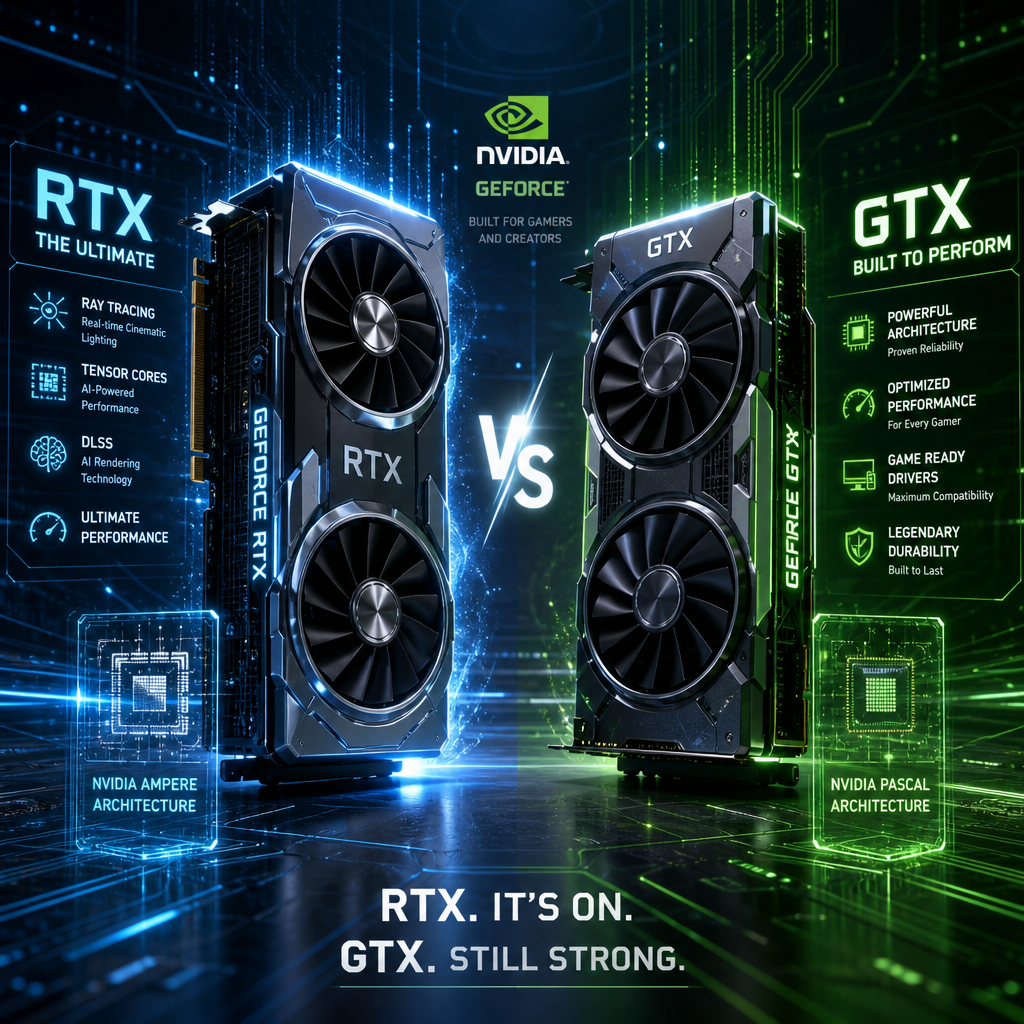
The RTX series is equipped with RT cores dedicated to ray tracing tasks, providing more realistic lighting, shadows, and reflections in games. GTX lacks dedicated RT cores, which means it doesn’t support real-time ray tracing in the same way or to the same degree.
2. AI and DLSS
RTX uses Tensor cores to accelerate AI-driven tasks, such as NVIDIA’s DLSS technology, which the GTX series does not support. DLSS allows for performance improvements without sacrificing visual quality by using AI to upscale lower resolution images.
3. Performance Levels
Due to its advanced architecture and additional features, RTX GPUs generally offer better performance and efficiency, especially in applications that support ray tracing and AI enhancements, compared to their GTX counterparts.
4. Price Point
On the cost spectrum, RTX GPUs are generally more expensive due to their enhanced features. However, for users who do not require real-time ray tracing or AI capabilities, GTX offers a more budget-friendly option.
Which One Should You Choose?
The choice between RTX and GTX largely depends on your usage needs and budget:
- For Gamers: If you want the latest graphical advancements and are looking to future-proof your system with cutting-edge technology like ray tracing, investing in an RTX GPU is advisable.
- For Content Creators: Professionals in video editing or 3D rendering might benefit more from the performance enhancements provided by RTX’s AI features.
- For Budget-Conscious Users: If affordability is a crucial factor, or if you mainly play esports titles that don’t require high-end graphics, a GTX card may be enough to suit your needs.
Conclusion
Understanding the differences between NVIDIA’s RTX and GTX series can help you make an informed decision. While the RTX series represents a major leap forward with technologies like ray tracing and AI-enhancements, the GTX series remains a solid choice for reliable performance at a lower cost.
Ultimately, your choice should align with your needs, be it advanced visual technology for a robust gaming experience, or a pocket-friendly solution that balances cost and performance. Whichever you choose, both series have proven to be leaders in the GPU market, ensuring quality and power in fulfilling modern computing needs.