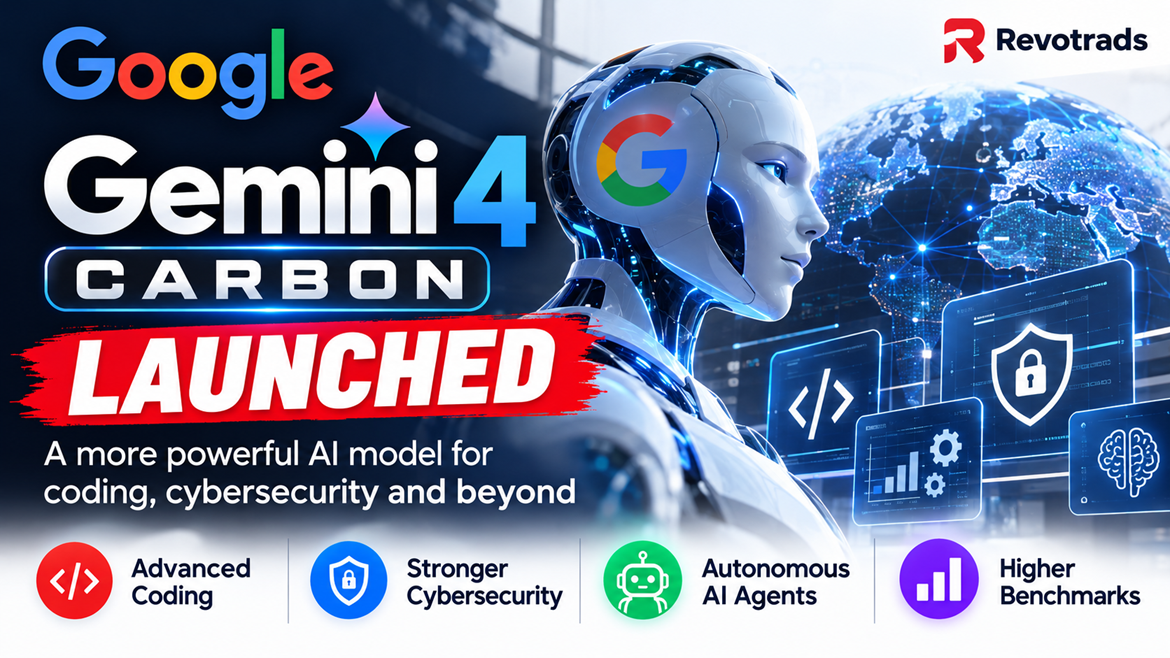
Google has introduced Gemini 4 Carbon, a powerful new artificial intelligence model designed to handle complex coding, cybersecurity, scientific reasoning, and long-running autonomous tasks.
Announced on October 28, 2026, Gemini 4 Carbon arrives just two weeks after the introduction of Gemini 4 Argon. This rapid release cycle demonstrates Google’s efforts to compete with OpenAI, Anthropic, and other major AI developers.
Unlike AI assistants primarily focused on answering questions or generating content, Gemini 4 Carbon is designed to tackle more demanding engineering challenges. Google says the model can investigate complicated software bugs, identify security vulnerabilities, generate code fixes, and work through multi-stage tasks over extended periods.
The launch also marks an important development in the AI industry’s shift toward autonomous systems capable of completing technical work with less continuous human intervention.
However, Gemini 4 Carbon is not yet generally available to the public. Google is initially providing access to selected cybersecurity defenders while evaluating additional safeguards before a broader rollout. blog.google+1
What Is Gemini 4 Carbon?
Gemini 4 Carbon is Google’s latest frontier AI model, developed by Google DeepMind as part of the Gemini 4 family.
A frontier AI model generally refers to a highly capable system designed to perform advanced tasks across reasoning, software development, analysis, and other complex domains.
Carbon builds on Gemini 4 Argon but introduces improvements in areas where AI systems have historically struggled, particularly maintaining accuracy and following instructions during long, complicated workflows.
Google has emphasized five major areas of improvement:
- Advanced software development and debugging.
- Cybersecurity vulnerability discovery and remediation.
- Autonomous, multi-step engineering workflows.
- Scientific reasoning and multimodal understanding.
- Reliability, alignment, and resistance to malicious instructions.
These improvements could eventually benefit software developers, enterprise IT teams, cloud service providers, and cybersecurity professionals.
Gemini 4 Carbon’s Biggest Features
1. Advanced AI coding and software engineering
One of the most significant upgrades is Gemini 4 Carbon’s ability to work on complex software engineering problems.
Traditional AI coding assistants are often effective at generating individual functions, explaining code, or suggesting straightforward bug fixes.
However, real-world software engineering involves understanding large repositories, identifying dependencies, testing changes, and troubleshooting unexpected failures.
Google says its internal teams have used Carbon for tasks that continued over multiple days, including identifying and resolving subtle problems across large codebases and low-level software systems.
Potential applications include reviewing unfamiliar codebases, finding the root causes of recurring bugs, suggesting improvements to existing applications, and supporting complex development projects.
This does not mean developers can safely deploy every AI-generated change without review. Human testing, security checks, and quality assurance remain essential.
2. Major improvements in cybersecurity
Cybersecurity is one of the headline features of Gemini 4 Carbon.
Google reports strong performance across three stages of defensive cybersecurity work: discovering vulnerabilities, determining whether vulnerabilities can be exploited, and producing fixes.
| 88.2% | 54.8% | 71.0% |
| SEC-bench Pro | ExploitGym | CWE-bench |
Google-reported Gemini 4 Carbon cybersecurity benchmark scores. Each benchmark measures a different task; percentages are not directly comparable. Source: Google DeepMind, October 28, 2026. blog.google
For businesses operating websites, cloud servers, and applications, stronger defensive AI could eventually assist with identifying vulnerable software components and prioritizing security patches.
Google also reports that Carbon more than doubled Argon’s success rate at generating secure code in its internal evaluations. This is a company-reported result, not a guarantee of real-world security outcomes.
3. Long-running autonomous AI agents
Another major advancement is Carbon’s ability to support sustained agentic workflows.
An AI agent differs from a basic chatbot because it can coordinate several steps toward a defined goal, potentially using tools, reviewing results, and adjusting its approach.
For example, an engineering agent might inspect an application, identify a bug, suggest a fix, run tests, and revise the proposed solution when tests fail.
Carbon is designed to maintain progress through difficult tasks rather than simply producing one response.
This capability could eventually make AI assistants more useful for large development teams and complex IT operations.
4. Better web development and multimodal understanding
Google has also reported improvements in full-stack web development and multimodal understanding.
In WebDev Arena, Carbon achieved a reported score of 1769, an improvement of 89 Elo points, placing it fourth in the evaluation cited by Google.
For developers and digital businesses, these improvements may support building application interfaces, improving existing websites, troubleshooting frontend and backend problems, and producing more polished development artifacts.
However, benchmark rankings are snapshots of particular evaluations and should not be treated as proof that a model will outperform competitors on every project.
5. Improved reliability and AI safety
As AI systems become capable of performing more complicated tasks, reliability becomes increasingly important.
Google says Gemini 4 Carbon improves several safety-related measures compared with Argon, including reducing unsupported claims, avoiding unnecessary actions, and resisting prompt-injection attacks.
In Google’s internal testing, Carbon produced approximately half as many unsupported claims as Argon.
The company also reported a 0% attack success rate on a specific indirect prompt-injection benchmark.
These results are promising, but they do not establish that Carbon is immune to hallucinations, manipulation, or security failures. Businesses should continue using access controls, monitoring, and human approval for sensitive operations. blog.google
Gemini 4 Carbon Benchmarks: How Powerful Is Google’s New AI?
Google reports that Gemini 4 Carbon achieved the top position on the updated Artificial Analysis Intelligence Index v5.0, scoring 59 points.
This places Carbon ahead of several leading frontier models on that particular evaluation.
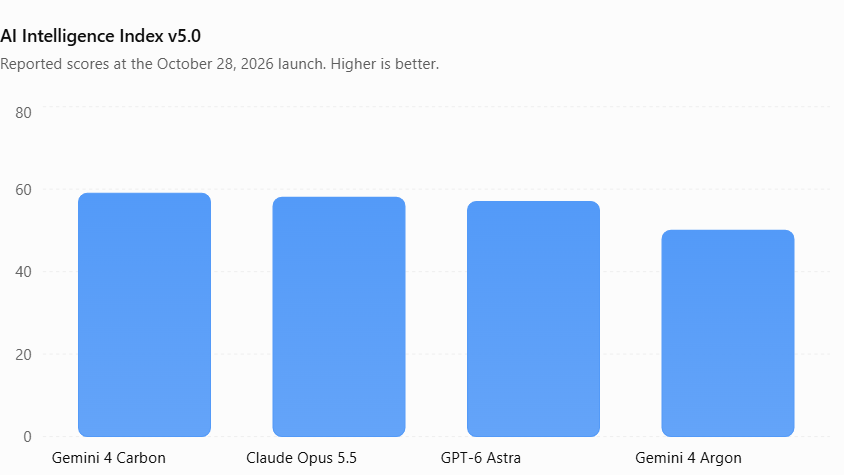
Scores reported in October 28 coverage of Artificial Analysis Intelligence Index v5.0. These are benchmark results, not universal rankings across every task.
Carbon’s score represents an improvement of nine points over Argon on this version of the index.
Nevertheless, model selection should depend on real-world requirements such as accuracy, reliability, latency, API pricing, data handling, and performance on representative workloads.
Gemini 4 Carbon vs Gemini 4 Argon
Although both models belong to Google’s Gemini 4 family, Carbon emphasizes more advanced software engineering and cybersecurity capabilities.
| Feature | Gemini 4 Argon | Gemini 4 Carbon |
|---|---|---|
| Launch | October 2026 | October 28, 2026 |
| AI Intelligence Index v5.0 | 50 | 59 |
| Coding | Advanced | Improved long-running engineering |
| Cybersecurity | Strong capabilities | Higher reported benchmark performance |
| Secure code generation | Baseline | Over 2× internal success rate |
| Availability | Publicly accessible | Selected defenders initially |
| Introductory API price | $2 / $10 per million tokens | $2 / $10 per million tokens |
The pricing figures represent input and output tokens, respectively. Carbon’s improved performance figures are based on Google’s published evaluations and reported benchmark comparisons. blog.google+1
For developers already using Argon, Carbon could become a useful upgrade once public access expands, particularly for complex coding and security-sensitive workflows.
Gemini 4 Carbon Pricing: How Much Will It Cost?
Google has announced introductory API pricing for Gemini 4 Carbon, although broad access has not yet begun.
| Pricing component | Introductory price | After introductory period |
|---|---|---|
| Input tokens, per 1 million | $2 | $4 |
| Output tokens, per 1 million | $10 | $20 |
| Cached input tokens | 95% introductory discount | Future terms not specified |
The initial cached-input discount implies approximately $0.10 per million cached input tokens at the introductory rate.
Google has not announced when the introductory pricing period will end. Actual usage costs will depend on the volume of input and output tokens, caching, and applicable billing conditions. blog.google
When Will Gemini 4 Carbon Be Available?
As of October 29, 2026, Gemini 4 Carbon has been officially announced, but general public access remains pending.
Google is beginning its rollout with a limited group of cybersecurity defenders and intends to extend access gradually to additional trusted partners through its Fairwind Program.
The company is also conducting safety evaluations before making Carbon available more broadly to developers, enterprises, and consumers.
No specific general-release date has been confirmed.
Readers should monitor Google’s official announcements rather than assume that the model is already available in every Gemini product or API.
How Gemini 4 Carbon Could Benefit Businesses in India
For Indian businesses, Gemini 4 Carbon’s potential value extends beyond conversational AI.
Software development companies could eventually use advanced agentic capabilities to investigate bugs, maintain applications, and assist with quality assurance.
Cloud hosting providers and enterprise IT teams may benefit from more capable security analysis, code review, and vulnerability remediation.
E-commerce businesses could use improved development capabilities to maintain websites, build integrations, and troubleshoot application issues.
Digital marketing agencies may also benefit indirectly through better tools for website development, analytics automation, and technical troubleshooting.
However, these are potential applications, not verified customer deployments of Carbon. The model’s practical value will become clearer after broader access and independent real-world testing.
Gemini 4 Carbon and the Future of AI Agents
The most important development behind Gemini 4 Carbon may be the growing emphasis on AI systems that can complete complex workflows over longer periods.
Early generative AI tools were largely focused on producing text, images, or individual code snippets.
More advanced models increasingly aim to coordinate tasks, work with software tools, assess intermediate results, and refine their actions.
This shift could reshape software development, cybersecurity operations, enterprise automation, and IT management.
At the same time, longer-running agents introduce additional concerns around permissions, unintended actions, cost control, data protection, and oversight.
The future of enterprise AI will therefore depend not only on intelligence but also on whether these systems can operate safely, transparently, and reliably.
Frequently Asked Questions About Gemini 4 Carbon
1. What is Gemini 4 Carbon?
Gemini 4 Carbon is a frontier AI model announced by Google DeepMind on October 28, 2026. It focuses on advanced coding, cybersecurity, reasoning, and long-running autonomous tasks.
2. Is Gemini 4 Carbon officially launched?
Yes. Google officially announced the model on October 28, 2026. However, its initial rollout is restricted to selected cybersecurity defenders.
3. Is Gemini 4 Carbon free?
Google has not confirmed a free public access tier for Carbon. It has announced introductory API pricing, but wider availability remains pending.
4. How much does Gemini 4 Carbon cost?
The introductory API pricing is $2 per million input tokens and $10 per million output tokens. Google has announced higher prices after the introductory period.
5. Is Gemini 4 Carbon better than Gemini 4 Argon?
Google reports substantial improvements over Argon in coding, cybersecurity, and several benchmark evaluations. Actual performance will depend on the task.
6. Can I use Gemini 4 Carbon in India?
General availability in India has not been confirmed as of October 29, 2026. The initial rollout is limited to selected cybersecurity defenders.
7. Is Gemini 4 Carbon better than ChatGPT or Claude?
Carbon leads the reported Artificial Analysis Intelligence Index v5.0 scores at launch, but no single benchmark establishes that it is better for every application. Performance, cost, access, and reliability should all be considered.
8. What makes Gemini 4 Carbon different?
Its distinguishing features include cybersecurity-focused capabilities, long-running autonomous engineering workflows, improved coding performance, and stronger reported safeguards.
Final Verdict: Is Gemini 4 Carbon a Major AI Breakthrough?
Google’s Gemini 4 Carbon launch is an important development in the competition to build more capable AI systems.
Its reported improvements in coding, cybersecurity, and long-running autonomous tasks suggest that frontier AI models are moving toward more sophisticated engineering and enterprise applications.
The model’s strong benchmark performance and announced introductory pricing make it particularly interesting for developers and organizations evaluating future AI solutions.
However, limited initial availability and the need for independent testing mean businesses should avoid making major adoption decisions based solely on launch-day benchmark results.
For now, Gemini 4 Carbon represents a promising advancement, with its broader impact dependent on real-world performance once Google expands access.
Revotrads will continue covering developments in artificial intelligence, cybersecurity, software tools, and emerging technology.