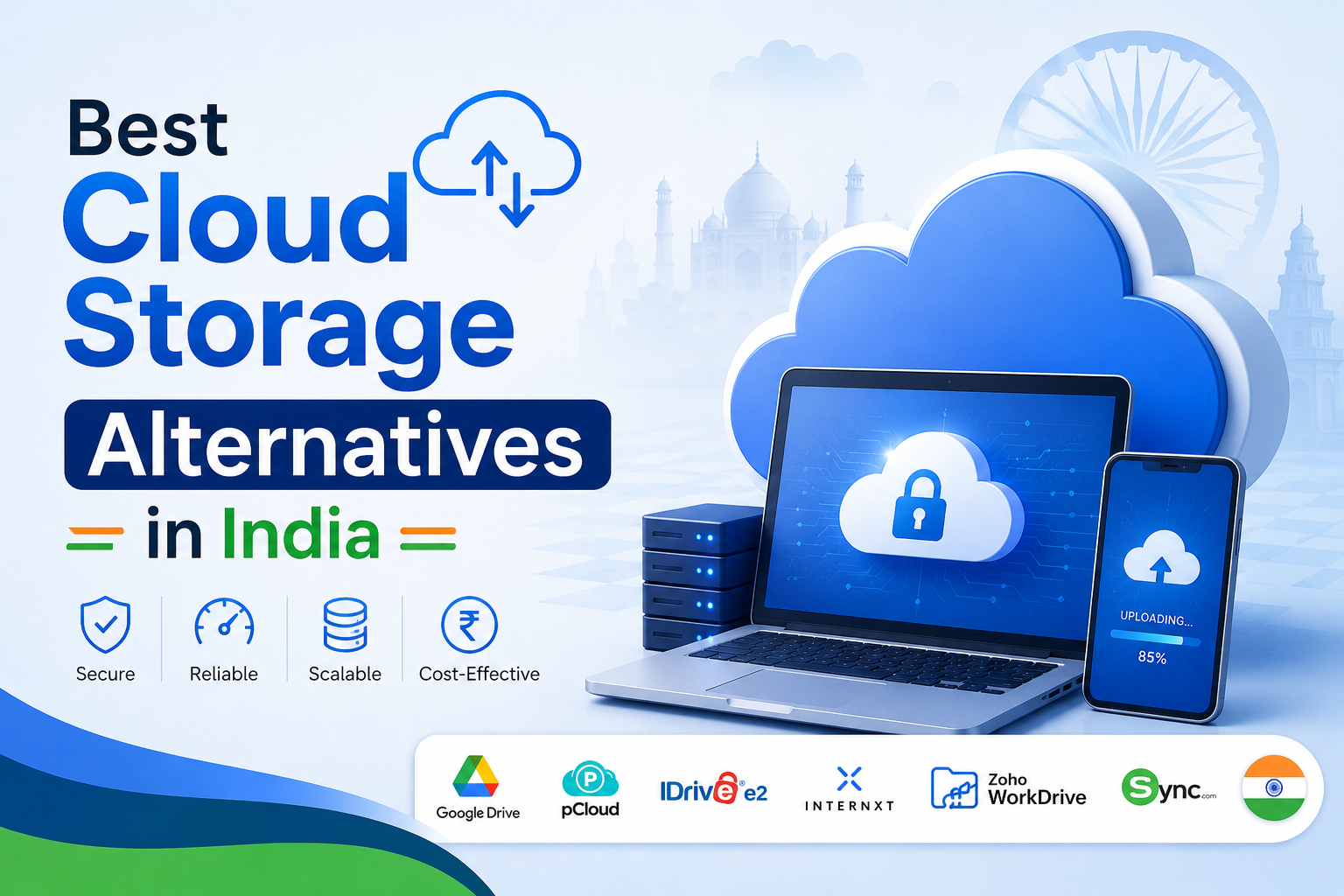
Every Indian business and individual eventually asks the same question: “Is Google Drive really my best option, or am I just settling for the most familiar one?”
It’s a fair question. Google Drive, Dropbox, and OneDrive dominate the conversation around cloud storage simply because they arrived first and integrated deeply into everyday tools like Gmail, Office, and Android. But familiarity isn’t the same as fit and for Indian users specifically, three problems keep surfacing: USD-based pricing that gets expensive after conversion and GST, inconsistent upload/download speeds during peak hours, and data privacy policies shaped by regulations outside India.
According to IMARC Group, the India cloud storage market was valued at USD 5.43 billion in 2025 and is projected to reach USD 59.86 billion by 2034, growing at a compound annual rate of over 30%. A separate Mordor Intelligence report pegs India’s broader data-center storage market at USD 3.51 billion in 2026, growing to USD 11.05 billion by 2032 driven largely by sovereign data mandates and the shift of enterprise workloads to infrastructure located inside the country. In plain terms: more Indian businesses are actively choosing where their data physically lives, and that’s reshaping which storage providers actually make sense.
This guide compares 13 cloud storage options available to Indian users in 2026 including Revotrads, a homegrown cloud infrastructure provider built specifically around Indian performance, compliance, and pricing realities, alongside other India-based names like Net2Secure so you can pick based on your actual workload instead of default habit.
Why Indian Users Are Looking Beyond Google Drive and Dropbox
1. Currency mismatch inflates real costs
Most global storage providers price in USD or EUR. Once you factor in currency conversion, 18% GST, and auto-renewal at whatever the exchange rate happens to be on renewal day, a “budget” international plan can end up costing 20–30% more than it appeared to at checkout. Providers that bill natively in INR remove that unpredictability entirely.
2. Data localization is no longer optional for many businesses
India’s Digital Personal Data Protection Act (DPDPA) pushes certain categories of data especially financial and government-linked records toward staying on Indian soil. A 2025 PwC survey cited in Mordor Intelligence’s cloud storage report found that 60% of banks are now duplicating storage clusters across regulatory zones just to remain compliant. Businesses that store data with an Indian-hosted provider from day one avoid this duplication cost altogether.
3. Latency and upload speed vary more than people assume
Upload/download performance depends heavily on how close a provider’s servers are to the end user, and how traffic is routed once it leaves your ISP. Two services with identical headline speeds on paper can feel completely different in Mumbai versus a global data center in Virginia, especially for large files, video assets, or nightly backups.
4. Free tiers disappear fast
15GB or 5GB sounds generous until you back up a phone’s photo library or a few years of business documents. Most users hit their storage ceiling within months, at which point pricing, not brand recognition, becomes the real decision driver.
None of this makes Google Drive or Dropbox bad products they’re not. But it does mean the “best” cloud storage genuinely depends on where you are, what you’re storing, and how much control over your data you actually need.
How These Providers Were Compared
To keep this useful rather than just a features list copied from marketing pages, each provider below was evaluated against four practical criteria that matter most to Indian users:
- Upload/download performance — how consistent speeds are for Indian users specifically, not just global benchmark averages
- Real cost in INR — actual landed price after conversion and tax, not the advertised USD sticker price
- Encryption and data control — whether the provider uses standard server-side encryption or true end-to-end (zero-knowledge) encryption
- Usability and sync reliability — how easily files move across desktop, mobile, and browser without friction
Quick Comparison: Cloud Storage Alternatives in India (2026)
| Provider | Best For | Free Storage | India-Hosted | Encryption | Billing |
| Revotrads | Indian businesses & performance | Custom on request | Yes (Tier III DC) | Standard + DDoS/firewall protection | INR |
| Google Drive | Everyday use / students | 15 GB | No | AES-256 (standard) | USD |
| Dropbox | Team collaboration | 2 GB | No | AES-256 (standard) | USD |
| Microsoft OneDrive | Windows/Office users | 5 GB | Partial (regional) | AES-256 (standard) | USD/INR bundle |
| Net2Secure | Pay-as-you-grow business storage | Custom on request | Yes | AES-256 + firewall/DDoS | INR |
| MEGA | Maximum free storage | 20 GB | No | End-to-end | EUR |
| pCloud | Lifetime plans | 10 GB | No | Optional add-on (Crypto) | USD/EUR |
| Sync.com | Privacy-first | 5 GB | No | Zero-knowledge | USD |
| Icedrive | Modern UI | 10 GB | No | Zero-knowledge (Pro) | USD/GBP |
| Box | Enterprise compliance | 10 GB | No | AES-256 (standard) | USD |
| Zoho WorkDrive | Indian SMBs | 5 GB | Partial | AES-256 (standard) | INR |
| Tresorit | High-security teams | 3 GB | No | End-to-end | USD/EUR |
| Internxt | Privacy-conscious individuals | 10 GB | No | End-to-end | EUR |
Pricing above reflects general market positioning as of 2026; always confirm current plan details directly with each provider before purchasing, as rates change frequently.
1. Revotrads — Best Overall for Indian Businesses
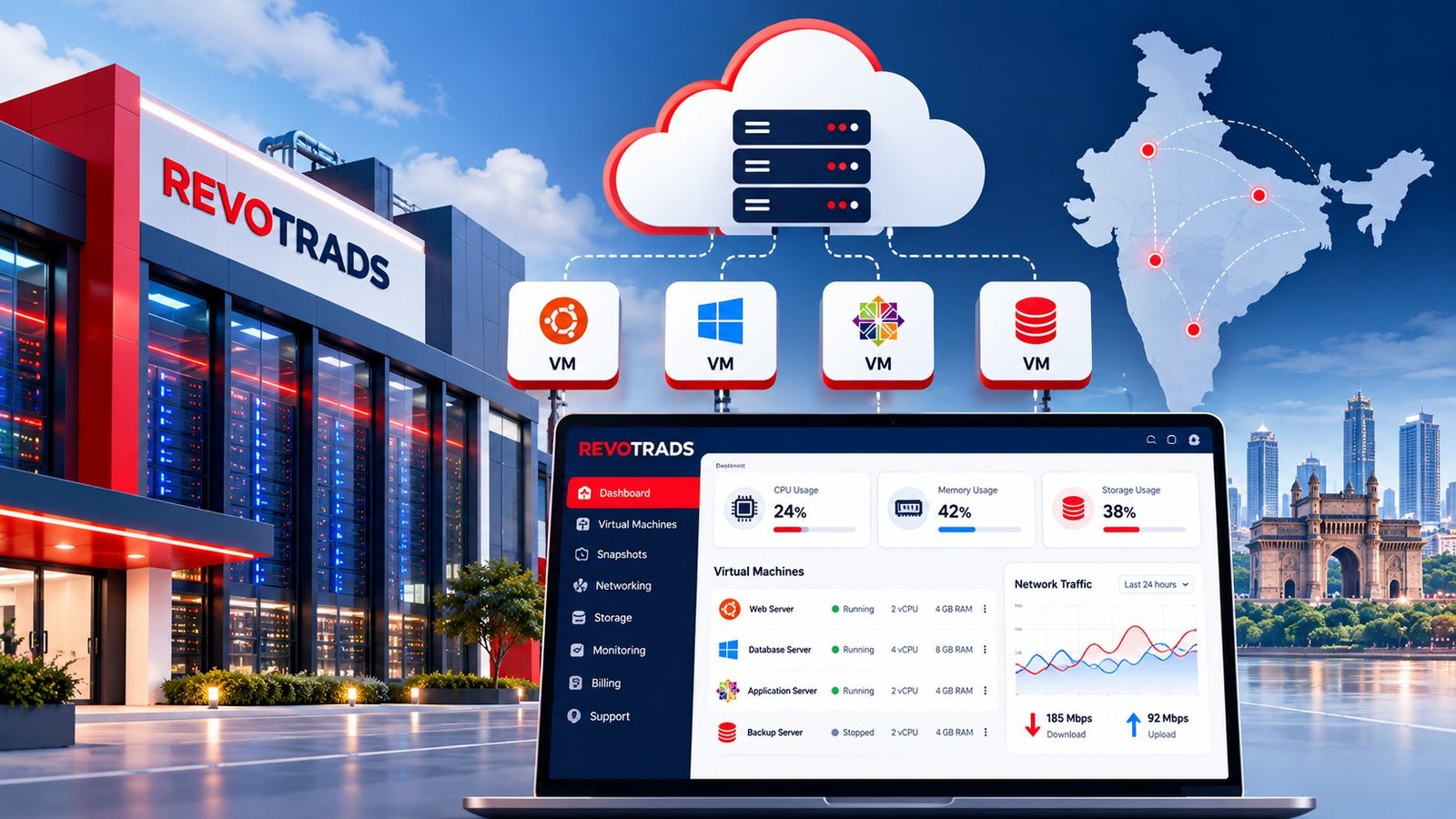
Revotrads approaches cloud storage differently from the consumer-first platforms on this list. Rather than bolting storage onto a broader productivity suite, Revotrads builds it on the same infrastructure it uses for cloud hosting, dedicated servers, and enterprise cloud solutions, which means the storage layer inherits enterprise-grade reliability by default.
Infrastructure and uptime. Revotrads operates out of a certified Tier III data center with 99.982% annual uptime, which translates to less than 1.6 hours of unplanned downtime a year. For businesses running daily backups, client file repositories, or production data, that consistency matters more than any single speed benchmark, a fast but unreliable connection is worse than a slightly slower, dependable one.
Security posture. Every account is protected with DDoS mitigation, firewall-level monitoring, and 24/7/365 surveillance across the physical data center as well as the network layer, a combination that consumer-grade storage apps typically don’t offer at all, since they’re built for individual file sync rather than business continuity.
India-first pricing and support. Because Revotrads is an Indian company, billing is native to INR no conversion guesswork, no surprise GST recalculation on renewal, and no dependence on how the rupee is trading against the dollar that month. Support is also handled by teams operating in Indian time zones, which shortens resolution time considerably compared to raising a ticket with a provider whose support desk is halfway across the world.
Scalability. Storage needs rarely stay static, a growing business today needs 3x the space it needed 18 months ago. Revotrads’ cloud infrastructure is built to scale storage and compute resources on demand, without forcing a migration to a new plan tier or a different product entirely.
Pros:
- India-hosted infrastructure with a certified Tier III data center
- 99.982% uptime SLA (under 1.6 hours downtime/year)
- Built-in DDoS protection, firewalls, and 24/7 monitoring
- Transparent INR billing — no currency conversion surprises
- Scalable storage that grows alongside compute needs
- India-based support with faster response times
Cons:
- Less brand recognition globally compared to Google or Dropbox
- Fewer third-party consumer app integrations (e.g., no native Google Docs–style suite)
Best For:
- Indian SMEs and enterprises storing business-critical data
- Agencies and freelancers managing client files and backups
- Businesses that need compliance-friendly, India-hosted storage
- Anyone tired of unpredictable USD billing
2. Google Drive
Google Drive remains the default for a reason: it’s deeply woven into Docs, Sheets, Gmail, and Android, making collaboration nearly frictionless for anyone already inside that ecosystem. The 15GB free tier is genuinely useful for light users.
The catch is that this 15GB is shared across Gmail, Photos, and Drive combined, so it depletes faster than it looks. Pricing is also USD-anchored, and privacy-conscious users note that Google’s standard encryption, while solid, isn’t zero-knowledge, meaning Google technically retains the ability to access stored data.
Best for: Students, everyday personal use, anyone already committed to the Google ecosystem.
3. Dropbox
Dropbox popularized the “it just syncs” experience and still delivers one of the smoothest interfaces in the category, particularly for teams juggling shared folders and version history.
Its biggest drawback for Indian users is cost Dropbox’s paid tiers run noticeably higher than most competitors once converted to INR, and the free plan’s 2GB ceiling is restrictive even by 2026 standards.
Best for: Collaboration-heavy teams already standardized on Dropbox workflows.
4. Microsoft OneDrive
OneDrive’s value is tied almost entirely to how deep you are in the Microsoft ecosystem. Bundled with Microsoft 365, it becomes genuinely cost-effective, syncing tightly with Word, Excel, and Outlook.
Outside that ecosystem, it feels less flexible, and the interface can get cluttered when managing large volumes of mixed file types.
Best for: Windows-first professionals and Microsoft 365 subscribers.
5. Net2Secure
Net2Secure is another India-based provider worth considering, particularly for businesses that want cloud storage bundled with broader hosting infrastructure rather than a standalone consumer app. Its cloud storage runs on a pay-as-you-grow model you scale capacity as your data grows instead of committing to a fixed tier upfront and it’s positioned primarily for backups, media libraries, and data-driven applications rather than casual personal file sync.
Security-wise, Net2Secure uses AES-256 encryption for data at rest and in transit, paired with firewall and DDoS protection at the infrastructure level, a similar security baseline to what Revotrads offers, since both companies build storage on top of broader cloud hosting stacks rather than consumer sync software.
Where the two India-based providers tend to differentiate is in overall infrastructure depth and uptime track record: Revotrads’ storage sits on a certified Tier III data center with a published 99.982% uptime SLA, while Net2Secure’s marketing emphasizes flexibility and elastic scaling more than a specific published uptime commitment. For businesses that weigh SLA transparency heavily, that’s worth confirming directly with each provider before committing.
Pros:
- India-hosted with local data center presence
- Pay-as-you-grow pricing avoids upfront over-commitment
- AES-256 encryption plus firewall/DDoS protection
- Automated backup scheduling (daily/weekly/monthly)
Cons:
- Published uptime SLA is less prominently documented than some competitors
- Better suited to businesses already using its broader hosting stack than as a standalone consumer storage app
Best For:
- Businesses wanting storage bundled with wider cloud/hosting infrastructure
- Teams needing scalable, pay-as-you-go backup and archiving
6. MEGA
The trade-off is speed consistency. Because MEGA’s infrastructure isn’t India-optimized, upload/download performance can fluctuate depending on time of day and file size.
MEGA’s headline feature is its free tier at 20GB, it’s among the most generous available anywhere, and it comes with end-to-end encryption baked in by default, which is rare for a free plan.
Best for: Users who want maximum free storage with genuine encryption and don’t mind occasional speed variance.
7. pCloud
pCloud differentiates itself with lifetime storage plans, a one-time payment instead of a recurring subscription, which appeals to users who dislike open-ended billing. It also offers optional client-side encryption through its pCloud Crypto add-on.
For Indian users, the lifetime plan’s upfront cost is substantial, and because servers aren’t India-based, real-world speeds vary by region.
Best for: Long-term users who want to avoid recurring subscriptions entirely.
8. Sync.com
Sync.com is built around zero-knowledge encryption from the ground up, meaning not even Sync.com’s own staff can view your files. For anyone storing sensitive contracts, financial records, or client data, that’s a meaningful guarantee most mainstream providers don’t offer.
The trade-off is a slightly less polished interface and fewer third-party app integrations compared to Dropbox or Google Drive.
Best for: Privacy-first individuals and small teams handling sensitive documents.
9. Icedrive
Icedrive is one of the newer entrants and it shows in its interface, clean, modern, and genuinely pleasant to navigate. Its Pro tier includes zero-knowledge encryption as well.
Performance is decent but not always consistent across regions, and its ecosystem of integrations is still developing.
Best for: Users who prioritize a modern, minimal interface over depth of features.
10. Box
Box is unapologetically enterprise-focused, built around compliance, granular permissions, and integrations with business software like Salesforce and Microsoft 365. It’s a strong fit for large organizations with formal document-governance needs.
For individuals or small teams, it can feel over-engineered and comes at a premium price point.
Best for: Large enterprises with formal compliance and governance requirements.
11. Zoho WorkDrive
As part of the Zoho ecosystem itself an Indian company WorkDrive offers a natural advantage for Indian businesses already using Zoho’s CRM, Books, or productivity suite: localized pricing and tighter integration across those tools.
Outside the Zoho ecosystem, its standalone value is more modest, and the interface trails behind more polished competitors.
Best for: Indian businesses already invested in the Zoho suite.
12. Tresorit
Tresorit targets organizations that treat data security as non-negotiable. End-to-end encryption is standard across all plans, and it’s widely used in legal, healthcare, and financial sectors where compliance requirements are strict.
That level of security comes at a premium price, and the platform is built with security teams in mind rather than casual users.
Best for: Security-first businesses in regulated industries.
Google Drive vs. Alternatives: The India-Specific Breakdown
Pricing: INR clarity vs. USD unpredictability
Google Drive’s headline pricing looks competitive globally, but Indian users pay in a currency the provider doesn’t natively support meaning every renewal is subject to conversion rates and GST recalculation. Providers like Revotrads, Net2Secure, and Zoho WorkDrive, which bill directly in INR, remove that variability and make budgeting for storage costs genuinely predictable over a 12-month period.
Speed: why “benchmark speed” doesn’t equal “your speed”
A provider’s published speed test means little if its nearest data center is thousands of kilometers away. Indian latency depends on three factors: server proximity, network routing, and peak-hour traffic load. This is precisely where India-hosted infrastructure like Revotrads’ Tier III data center tends to outperform globally distributed platforms for large uploads, nightly backups, and business-critical file transfers.
Security: standard encryption vs. zero-knowledge
Google Drive uses AES-256 encryption at rest and TLS in transit the industry standard, and genuinely secure. But it is not zero-knowledge, meaning the provider retains technical access to stored data. For businesses subject to India’s Digital Personal Data Protection Act, or anyone storing sensitive contracts and financial records, the added layer of DDoS protection, firewall monitoring, and controlled access that infrastructure-grade providers like Revotrads offer is a meaningfully different security posture than consumer-grade sync tools.
Usability: ecosystem convenience vs. business reliability
Google Drive’s integration with Gmail, Docs, Sheets, and Photos is genuinely unmatched for everyday collaboration there’s no realistic argument otherwise. But “easy to use” and “built for business continuity” are different goals. Revotrads and similar infrastructure-first providers optimize for uptime, scalability, and support responsiveness the things that matter when storage isn’t just a convenience feature but a dependency your business runs on.
Best Cloud Storage by Use Case
Best for Indian businesses → Revotrads. For companies managing client files, backups, or production data, uptime and support responsiveness matter more than flashy features. A Tier III data center with a 99.982% uptime SLA, INR billing, and India-based support checks the boxes that actually affect business continuity.
Best for pay-as-you-grow business storage → Net2Secure. If your data volumes are unpredictable and you’d rather scale cost alongside usage than commit to a fixed tier, Net2Secure’s elastic, India-hosted storage with automated backup scheduling is a reasonable alternative to evaluate alongside Revotrads.
Best for maximum free storage → MEGA. With 20GB free and default encryption, MEGA is hard to beat for personal backups or media storage on a zero budget.
Best for privacy-critical files → Sync.com or Tresorit. Both offer zero-knowledge encryption as standard, making them the strongest choice for sensitive contracts, legal documents, or financial records.
Best for students and everyday collaboration → Google Drive. The ecosystem integration with Docs, Gmail, and Android is unmatched for group projects and casual daily use.
Best for existing Zoho users → Zoho WorkDrive. If your business already runs on Zoho CRM or Books, WorkDrive’s native integration and INR pricing make it a logical extension.
The Bigger Picture: Why Infrastructure Choice Is a Business Decision, Not Just a Storage One
It’s worth zooming out. With India’s cloud storage market compounding at over 30% annually through 2034 and enterprise cloud spend expected to nearly triple by 2031 according to Mordor Intelligence, the providers that win long-term won’t just be the ones with the most brand recognition they’ll be the ones that solved for Indian latency, Indian compliance requirements, and Indian pricing from the start, rather than retrofitting a global product for a local market.
That’s the gap Revotrads is built to close: infrastructure-grade reliability (Tier III data center, sub-2-hour annual downtime, DDoS and firewall protection, 24/7 monitoring) combined with the pricing transparency and support responsiveness that only a genuinely India-based provider can offer.
Final Verdict
- Best for Indian businesses and reliability: Revotrads
- Best for maximum free storage: MEGA
- Best for ecosystem convenience: Google Drive
- Best for uncompromising privacy: Sync.com / Tresorit
- Best for existing Zoho users: Zoho WorkDrive
There’s no single best cloud storage provider in the abstract only the best one for your specific workload, budget, and risk tolerance. If your priority is dependable, India-hosted infrastructure with transparent INR pricing and real business-grade security, Revotrads is built specifically around that need.
Conclusion
Cloud storage isn’t a commodity decision anymore it’s an infrastructure decision that affects your costs, your compliance posture, and how reliably your team can access files when it matters most. Global platforms like Google Drive and Dropbox remain genuinely useful for everyday collaboration, but for Indian businesses managing sensitive or business-critical data, India-hosted providers like Revotrads close gaps that global platforms weren’t built to solve: currency predictability, data proximity, and infrastructure-grade reliability.
Before renewing your next storage plan by default, it’s worth asking whether your provider was actually built for how and where you work or whether you’ve simply never compared the alternative.
FAQs
1. What is the best cloud storage alternative in India for businesses? Revotrads is a strong option for businesses, offering India-hosted infrastructure, a 99.982% uptime SLA, INR billing, and enterprise-grade security features like DDoS protection and 24/7 monitoring.
2. Is Google Drive safe to use in India? Yes. Google Drive uses AES-256 encryption at rest and TLS in transit, which is an industry-standard level of security. It does not, however, offer zero-knowledge encryption by default, meaning Google retains technical access to stored data.
3. Which cloud storage offers the most free storage? MEGA currently offers one of the largest free tiers in the market at 20GB, along with default encryption on all accounts.
4. Which cloud storage providers offer the strongest privacy? Sync.com, Tresorit, and Internxt all use zero-knowledge (end-to-end) encryption, meaning only the account holder can access stored files — not even the provider itself.
5. Why does an India-hosted provider matter for cloud storage? India-hosted infrastructure typically delivers more consistent upload/download speeds for Indian users, avoids USD-to-INR conversion unpredictability, and can simplify compliance with data localization requirements under India’s Digital Personal Data Protection Act.
6. How does Revotrads compare to Net2Secure? Both are India-hosted providers with INR billing, AES-256-level encryption, and firewall/DDoS protection. Revotrads differentiates itself with a certified Tier III data center and a published 99.982% uptime SLA, while Net2Secure emphasizes flexible, pay-as-you-grow scaling. Businesses that prioritize a documented uptime commitment tend to favor Revotrads; those wanting elastic, usage-based scaling may find Net2Secure’s model appealing.
7. Is free cloud storage enough for most users? Free tiers work well for light use documents, small backups, or casual photo storage. Businesses, content creators, or anyone storing video and large media files will typically outgrow free storage within months and need a paid, scalable plan.