For more than twenty-five years, the fundamental gateway to the digital world has remained unchanged. You open a clean white page, type a few keywords into a rectangular box, and scroll through a list of blue links.
As of this week, that era is officially over.
At its flagship I/O 2026 developer conference, Google unveiled the most radical redesign to its flagship product since its inception in 1998. Driven by the release of its ultra-fast Gemini 3.5 Flash model, Google is transitioning from a search engine that finds information into an ecosystem of autonomous “AI agents” that do the work for you.
For platforms like Revotrads and the broader digital ecosystem, this isn’t just a UI update, it is a complete rewriting of how users interact with the web.
Beyond the Keywords: The New Multimodal Interface
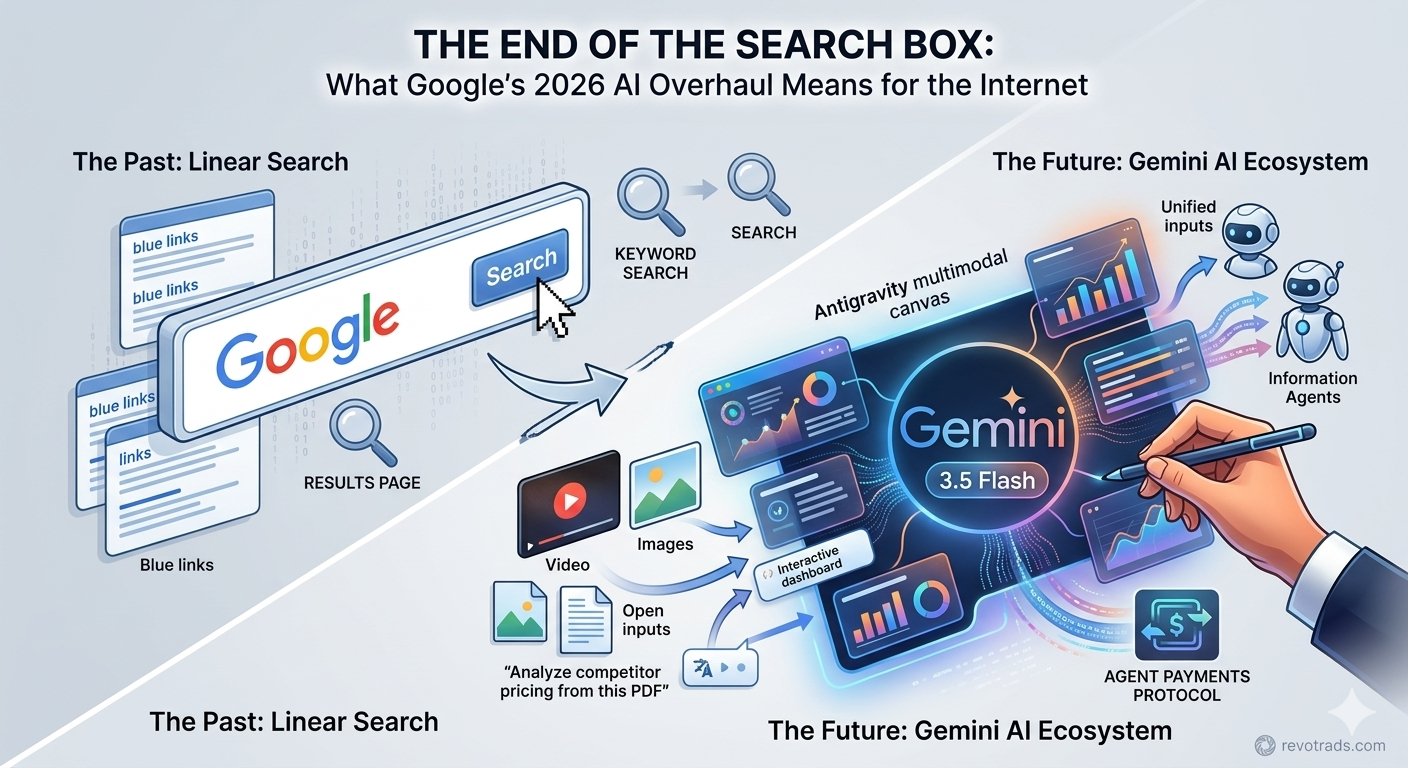
The iconic, static search box has been replaced with an expanding, fluid canvas. Users are no longer forced to figure out the perfect combination of keywords. Instead, the new interface allows users to drag and drop complex combinations of inputs simultaneously, including text, images, long documents, videos, and even active browser tabs.
If a user drops a financial statement and an open tab of a competitor’s product into the search bar, the engine doesn’t return articles about financial analysis. Instead, it instantly creates what Google calls a Generative UI. Powered by its new platform, Antigravity, Google Search codes and builds customized dashboards, charts, interactive calculators, and simulations on the fly to answer that highly specific query.
The Rise of “Information Agents”
The most disruptive shift for digital businesses is the introduction of Information Agents. Moving past traditional search, where a user triggers a query and receives a snapshot response, these agents operate continuously in the background.
Instead of searching for product updates, market drops, or apartment listings every morning, users can command an AI agent to monitor the web 24/7. Built on a sophisticated reasoning layer, these agents monitor blogs, real-time finance feeds, social media platforms, and e-commerce infrastructure, synthesizing conflicting viewpoints and pushing actionable alerts to the user only when specific, user-defined criteria are met.
To turn these agents into true economic actors, Google also debuted the Agent Payments Protocol. This framework establishes a secure, verifiable link between the user, the AI agent, and payment networks, allowing background agents to securely complete transactions, book services, and buy products within boundaries defined by the user.
The Impact on Web Traffic and Digital Platforms
For years, digital platforms have relied on the traditional pipeline: rank high on Google, earn the click, and convert the user on your website. However, with AI Overviews already serving billions of users and conversational “AI Mode” queries doubling quarter over quarter, the web is rapidly shifting toward a “zero-click” reality.
When Google’s AI synthesizes data directly inside the search interface or executes tasks via background agents, the traditional user visit changes shape. Forward-thinking digital entities must adapt to this agentic landscape:
- From SEO to AIO (AI Optimization): Structuring data cleanly using open industry standards (like the Universal Commerce Protocol) ensures that autonomous AI agents can read, understand, and accurately interact with your platform’s offerings.
- Prioritizing Deep Context and Authority: Simple, keyword-stuffed content will easily be absorbed and summarized by Google’s interface. True value will lie in proprietary data, deeply nuanced insights, and interactive utilities that AI cannot easily replicate.
- The API-First Economy: As agents take over the browsing habits of millions, optimization will no longer be just about human readability, but about ensuring seamless integration with agent protocols.
Looking Ahead
Google’s data shows that despite predictions that AI would hollow out its core business, query volume and search ad revenues hit all-time highs last quarter. Users want more complex answers, and they want them faster.
The search box is no longer an index of where to look; it has become an engine that executes intent. For digital businesses and platforms looking to thrive over the next decade, the challenge is clear: stop optimizing exclusively for clicks, and start building infrastructure that AI agents can seamlessly interact with.