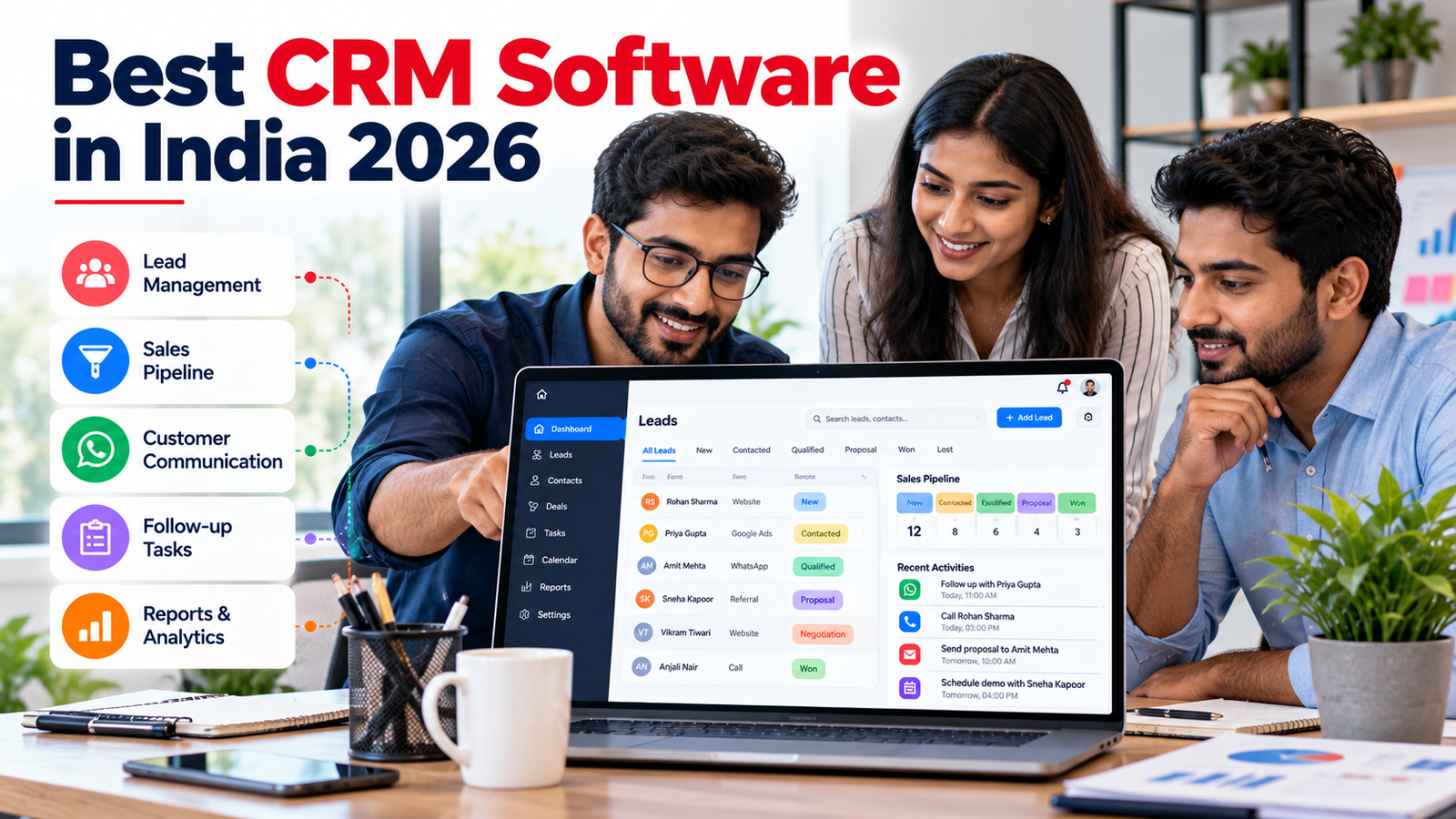
Managing customers is one of the biggest challenges for a growing small business. Leads arrive through websites, Google Ads, Meta Ads, WhatsApp, phone calls, and online marketplaces. Without a proper system, enquiries get missed, follow-ups are delayed, and sales teams struggle to track opportunities.
This is where customer relationship management (CRM) software becomes valuable.
The best CRM software in India helps businesses organize customer information, manage sales pipelines, automate follow-ups, and understand which marketing channels generate opportunities.
However, choosing the right CRM is not simply about selecting the platform with the most features. A five-person business has different requirements from a large sales organization. Indian businesses may also need WhatsApp integration, IndiaMART lead capture, GST invoices, local support, and affordable pricing in Indian rupees.
In this guide, we compare 10 CRM software options for small businesses in India in 2026, including Telemantix, Zoho CRM, Freshsales, HubSpot, Kylas, and other established solutions.
We examine their advertised capabilities, pricing models, advantages, limitations, and ideal use cases so that you can create a practical shortlist.
Quick Answer: Which Is the Best CRM Software in India?
Telemantix is a promising option for Indian small businesses that depend on WhatsApp conversations, advertising leads, and regular sales follow-ups. Its free plan and published rupee pricing make it worth evaluating for budget-conscious teams.
Zoho CRM is another strong option for businesses that need extensive customization and a mature CRM ecosystem. Freshsales is worth considering for teams that prioritize sales communication, while HubSpot can be attractive to companies combining CRM with inbound marketing. Kylas may suit growing teams that prefer a flat-fee licensing model.
There is no universal winner. The best CRM depends on your lead sources, team size, required integrations, monthly budget, and how your employees actually work.
Key Takeaways
- Telemantix: Worth shortlisting for WhatsApp-led sales workflows and Indian advertising lead sources.
- Zoho CRM: Suitable for businesses looking for a broad CRM platform with room for customization.
- Freshsales: Focuses on sales communication, deal management, and workflow automation.
- HubSpot: Offers a free entry point and a broader marketing, sales, and service ecosystem.
- Kylas: Worth comparing when a growing number of users makes per-seat pricing expensive.
- CRM costs should include GST, additional users, WhatsApp messaging, telephony, implementation, and training.
- Free CRM software can be sufficient for very small teams, but record limits and integrations matter.
- Before purchasing, test lead capture, follow-up reminders, reporting, and data export using real business scenarios.
What Is CRM Software?
CRM stands for Customer Relationship Management.
CRM software is a centralized system used to manage customer information, sales activities, business opportunities, and communication history.
Instead of maintaining customer details across Excel spreadsheets, email inboxes, WhatsApp chats, and notebooks, a CRM organizes relevant information in one place.
For example, consider a small digital marketing agency receiving 50 enquiries through its website and advertising campaigns.
Without a CRM, employees may manually copy enquiries into spreadsheets, assign leads through messaging groups, and remember follow-ups individually.
With an appropriately configured CRM, leads can enter a shared workspace, be assigned to sales representatives, move through pipeline stages, and generate follow-up tasks.
This does not automatically guarantee more sales. However, it gives managers better visibility into sales activities and makes it easier to identify missed opportunities.
Why Small Businesses in India Need CRM Software
Small businesses often begin with spreadsheets because they are inexpensive and familiar.
As enquiry volume grows, spreadsheets become harder to maintain consistently.
Multiple employees may update the same records, contact histories become fragmented, and managers struggle to determine which opportunities need attention.
A CRM addresses these operational problems by providing a structured sales process.
Better Lead Management
CRM software helps collect enquiries from different sources and organize them into a consistent database.
Depending on the platform, leads may be imported manually or captured automatically through supported integrations.
Faster Sales Follow-Ups
Sales teams can schedule calls, create tasks, and set reminders.
This reduces dependence on individual memory, especially when representatives manage many prospects simultaneously.
Improved Sales Pipeline Visibility
A sales pipeline shows the current stage of each opportunity.
For example, a business might use the stages New Lead, Contacted, Qualified, Proposal Sent, Negotiation, Won, and Lost.
More Organized Customer Communication
CRM platforms can preserve relevant communication history, notes, and activity records.
The exact level of integration with WhatsApp, email, and telephony differs between products and plans.
Better Reporting
Managers can analyze leads by source, salesperson, pipeline stage, and conversion outcome.
Reporting is most useful when the underlying data is entered accurately and consistently.
Top 10 Best CRM Software in India: Comparison Table
| CRM Software | Best For | Free Option | Pricing Approach |
|---|---|---|---|
| 1. Telemantix | WhatsApp, ad leads, Indian sales workflows | Free plan | From ₹549/month + GST |
| 2. Zoho CRM | Customizable sales management | Free for 3 users | From ₹800/user/month, billed annually |
| 3. Freshsales | Sales communication and pipelines | Trial available | From $9/user/month, billed annually |
| 4. HubSpot CRM | Inbound marketing and sales | Free for up to 2 users | Paid plans available |
| 5. Kylas CRM | Growing teams preferring flat-fee pricing | Free edition | Flat-fee paid plans |
| 6. Bigin by Zoho CRM | Simple sales pipelines | Free option | Affordable per-user plans |
| 7. LeadSquared | High-volume lead management | Contact sales | Plan and requirement dependent |
| 8. Pipedrive | Visual deal pipelines | Trial available | Subscription per seat |
| 9. TeleCRM | Calling-focused sales teams | Trial availability varies | Per-user subscription |
| 10. Bitrix24 | CRM with team collaboration | Free option | Organization-based paid plans |
Pricing note: Figures are indicative published starting prices checked in October 2026. Billing periods, taxes, usage limits, promotions, and feature availability can change. Prices are not directly comparable because vendors use different licensing models.
1. Telemantix: Best Starting Point for WhatsApp-Led Sales Teams in India
Website: https://telemantix.com/
Telemantix is an India-focused sales CRM designed to bring customer enquiries, sales pipelines, follow-up activities, and WhatsApp conversations into a connected workspace.
It is particularly relevant for businesses that generate leads through advertising campaigns, websites, messaging platforms, and Indian business directories.
Many small businesses struggle not because they lack enquiries but because their teams cannot consistently organize and follow up with those enquiries.
Telemantix aims to address that challenge through lead management, task tracking, pipeline visibility, automation, and communication tools.
Key Features of Telemantix
Centralized Lead Management
Telemantix provides a workspace for managing leads, contacts, sales opportunities, and associated activities.
Sales representatives can view lead information and track progress through defined stages.
Sales Pipeline Management
Businesses can configure pipeline stages to reflect their sales process.
This can help teams monitor enquiries from the first interaction through qualification, proposal, and closure.
WhatsApp CRM Integration
Telemantix advertises a shared WhatsApp inbox, bot flows, and approved-template campaigns.
These capabilities may be useful for businesses that communicate with customers primarily through WhatsApp.
WhatsApp Business Platform requirements, Meta approval, messaging policies, and additional message charges still apply.
Lead Capture From Advertising Platforms
The Pro plan advertises integrations with Meta Lead Ads and Google Ads.
This may reduce manual lead entry for businesses generating enquiries through digital advertising.
Indian Lead-Source Integrations
The Enterprise plan lists integrations with services including IndiaMART, JustDial, 99acres, Housing.com, and TradeIndia.
These sources may be relevant to real estate agencies, manufacturers, suppliers, and service providers.
Sales Automation
Telemantix offers workflow automation features, with allowances varying by plan.
Automation can help assign leads, create tasks, and support consistent follow-up processes.
Reporting and Lead Scoring
Higher plans advertise analytics and lead-scoring capabilities to help teams review opportunities.
Telemantix Pricing in India
| Plan | Published Price | Main Allowance |
|---|---|---|
| Free | ₹0 | 1 user, 500 leads |
| Pro | ₹549/month + GST | 1 user, 10,000 leads |
| Enterprise | ₹1,049/month + GST | 1 user, 100,000 leads |
| Additional user | ₹249/month | Per extra user on paid plans |
The vendor advertises a 14-day trial for paid plans. Its website states that the lead allowance counts every lead created in the workspace and that Meta WhatsApp message charges are separate.
Advantages
Telemantix combines several workflows relevant to Indian small businesses, including WhatsApp conversations, advertising leads, follow-up tasks, and sales pipelines.
Its published INR pricing and free single-user plan make the initial cost relatively easy to evaluate.
Limitations
The free plan supports one user and has a 500-lead allowance.
Businesses requiring particular lead-source integrations may need higher plans.
Before purchasing, confirm the exact WhatsApp setup requirements, connector availability, export capabilities, user permissions, and total cost for your team.
Who Should Choose Telemantix?
Telemantix is worth testing for:
- Digital marketing agencies.
- Real estate sales teams.
- Small B2B service providers.
- Education and training businesses.
- Local service companies.
- Businesses generating enquiries through Meta Ads, Google Ads, and WhatsApp.
Editorial assessment: Telemantix earns the first position in this guide because of its relevance to the requested India-focused, lead-generation use case. This is not a claim that it has outperformed competitors in independent testing.
Explore Telemantix: https://telemantix.com/
2. Zoho CRM — Best for Customizable Sales Management
Website: https://www.zoho.com/crm/
Zoho CRM is an established customer relationship management platform used by businesses of different sizes.
It provides tools for managing leads, contacts, accounts, deals, tasks, and sales activities.
Zoho CRM may be attractive to businesses that expect their sales processes to become more complex as they grow.
Key Features
Zoho CRM includes lead and contact management, customizable pipelines, workflow automation, reporting, mobile access, and integrations.
The available features vary significantly by edition.
Businesses already using other Zoho products may find its ecosystem particularly relevant.
Pricing
Zoho’s published Indian pricing lists a free edition for up to three users.
Its Standard edition is listed at ₹800 per user per month when billed annually, with higher editions offering additional capabilities.
Advantages
Zoho CRM offers broad functionality, customization options, and a substantial ecosystem of business applications.
Limitations
Advanced configuration may require more setup and training than a simple pipeline CRM.
Some automation, analytics, and customization features require higher editions.
Best For
Growing Indian SMEs, B2B sales organizations, service companies, and businesses requiring a configurable CRM.
3. Freshsales — Best for Sales Communication and Deal Management
Website: https://www.freshworks.com/crm/
Freshsales is a sales CRM from Freshworks.
It combines contact management, deal tracking, sales communication, and workflow features.
The platform is worth considering for businesses that want sales activities and customer communication within a unified environment.
Key Features
Freshsales offers contact and account management, deal pipelines, email-related tools, phone and chat capabilities, and workflow automation.
Higher plans provide additional sales management and analytics features.
Pricing
Freshworks’ published pricing lists the Growth plan from $9 per user per month when billed annually on its international pricing page.
Regional prices and billing terms should be checked before purchase.
Advantages
Freshsales is relevant to teams seeking communication-focused sales workflows and structured deal management.
Limitations
Advanced capabilities, add-ons, and higher usage allowances can increase the total subscription cost.
Best For
Small and midsized B2B sales teams, service companies, and organizations that prioritize sales communication.
4. HubSpot CRM — Best for Inbound Marketing and Sales Alignment
Website: https://www.hubspot.com/products/crm
HubSpot CRM is part of HubSpot’s broader customer platform.
It is particularly relevant to businesses that want to connect marketing activities, customer records, sales opportunities, and service workflows.
Key Features
HubSpot provides contact management, deal tracking, activity records, forms, reporting, and selected marketing and sales tools.
Its broader platform offers additional capabilities through paid products and plans.
Pricing
HubSpot advertises free CRM tools for up to two users.
Its paid pricing varies by product, seats, billing arrangement, and promotional eligibility.
Advantages
HubSpot can support businesses that want to build a connected marketing and sales process.
Its free tools provide an accessible way to explore the platform.
Limitations
Costs can increase when businesses require more seats, advanced automation, reporting, or additional platform products.
Best For
Content-driven businesses, B2B companies, inbound marketing teams, and startups planning to expand their marketing and sales operations.
5. Kylas CRM — Best for Growing Teams That Prefer Flat-Fee Pricing
Website: https://kylas.io/
Kylas is a CRM platform designed for growing sales teams.
One of its distinguishing characteristics is its licensing approach, which emphasizes unlimited users on supported plans.
Key Features
Kylas provides lead and deal management, customizable pipelines, task tracking, reporting, and selected integrations.
Advanced automation, communication integrations, and security features vary by edition.
Pricing
Kylas advertises a free Embark edition and flat-fee paid plans.
Its pricing model may be appealing when a business needs to give CRM access to many employees.
However, record allowances and paid add-ons must be included in any cost comparison.
Advantages
The licensing model can simplify budgeting for organizations with larger teams.
Limitations
Some advanced capabilities and integrations require paid plans or add-ons.
A flat-fee model is not necessarily cheaper for a very small team.
Best For
Growing sales organizations that want to avoid rapidly increasing per-user subscription costs.
6. Bigin by Zoho CRM — Best for Simple Sales Pipelines
Website: https://www.bigin.com/
Bigin is a simpler CRM offering from Zoho, designed for small businesses that need a structured way to manage customers and deals without immediately adopting a complex enterprise-style CRM.
Key Features
Bigin focuses on contacts, pipelines, activities, and sales workflows.
It is intended to help small teams move beyond spreadsheets and organize everyday sales tasks.
Advantages
Bigin can be easier to evaluate when the business primarily needs a simple pipeline and follow-up process.
Limitations
Businesses requiring extensive customization or sophisticated sales operations should compare its capabilities with the full Zoho CRM platform.
Best For
Freelancers, small agencies, local service businesses, and teams implementing their first CRM.
7. LeadSquared — Best for High-Volume Lead Management
Website: https://www.leadsquared.com/
LeadSquared focuses on sales execution and lead management.
It is particularly relevant to businesses that handle large numbers of enquiries and need structured lead distribution and follow-up processes.
Key Features
Depending on the product and configuration, LeadSquared offers lead management, workflow automation, sales tracking, and capabilities for different sales teams.
Advantages
It is worth evaluating for organizations with high enquiry volumes and more demanding lead-management workflows.
Limitations
Its implementation requirements and pricing may be less suitable for very small businesses seeking a simple low-cost CRM.
Best For
Education businesses, financial services organizations, real estate companies, and high-volume sales operations.
8. Pipedrive — Best for Visual Sales Pipeline Management
Website: https://www.pipedrive.com/
Pipedrive is a sales-focused CRM known for its visual approach to deal tracking.
It helps sales teams organize opportunities, monitor activities, and manage pipelines.
Key Features
Pipedrive provides deal management, contact records, pipeline views, sales activities, and integrations.
Additional features and automation depend on the plan.
Advantages
Its pipeline-centered approach can make deal tracking straightforward for sales-focused teams.
Limitations
Businesses requiring extensive marketing automation or India-specific integrations should evaluate the necessary plans and add-ons.
Best For
Consultancies, agencies, B2B service providers, and sales teams that want clear pipeline visibility.
9. TeleCRM — Best for Calling-Focused Sales Teams
Website: https://telecrm.in/
TeleCRM is positioned toward sales teams that rely heavily on phone calls, follow-ups, and messaging.
It may be worth evaluating for businesses where representatives handle a large number of daily conversations.
Key Features
TeleCRM offers sales-oriented tools intended to help teams organize leads, track follow-ups, and manage calling workflows.
The exact calling, recording, and WhatsApp capabilities should be confirmed for the selected plan.
Advantages
Its sales communication focus may suit telecalling teams and organizations that prioritize frequent customer contact.
Limitations
Businesses should confirm telephony integrations, number provisioning, recording policies, and additional communication costs.
Best For
Inside-sales teams, telecalling operations, education enquiry teams, and businesses with phone-led sales processes.
10. Bitrix24 — Best for CRM and Team Collaboration
Website: https://www.bitrix24.com/
Bitrix24 combines CRM functionality with team collaboration and work-management tools.
It may be attractive to small businesses that want more than a dedicated sales pipeline application.
Key Features
Depending on the plan, Bitrix24 offers CRM, tasks, collaboration, communication, and related business tools.
Advantages
The combination of CRM and collaboration features can reduce the need for separate applications in some workflows.
Limitations
Businesses looking only for simple lead tracking may find a broader suite more complicated than necessary.
Best For
Small teams seeking a combined CRM, task management, and collaboration platform.
Best CRM Software India: Which Is Right for Your Business?
The most appropriate CRM depends on how your company attracts customers and manages its sales process.
| Business Type | CRM to Evaluate First | Reason |
|---|---|---|
| WhatsApp-led small business | Telemantix | Shared conversations and follow-up workflows |
| Digital marketing agency | Telemantix or HubSpot | Advertising leads and marketing-to-sales handoff |
| Small startup | Bigin or Zoho CRM | Structured pipelines and accessible entry plans |
| Growing B2B sales company | Zoho CRM or Freshsales | Deal management and customization |
| Large sales team | Kylas | Flat-fee licensing approach |
| High-volume lead operation | LeadSquared | Lead distribution and sales execution |
| Telecalling business | TeleCRM | Calling-oriented workflows |
| Consulting company | Pipedrive | Visual pipeline management |
| Team collaboration-focused business | Bitrix24 | CRM plus workplace tools |
These are recommendations for shortlisting, not independently measured product rankings.
Essential Features to Look for in CRM Software
1. Lead Capture and Management
A CRM should make it easy to collect, import, assign, and update leads.
Before buying, check whether the software supports your actual lead sources, such as website forms, Google Ads, Meta Ads, IndiaMART, and other directories.
2. Sales Pipeline Management
Choose a CRM that allows your team to track each opportunity through the stages of your sales process.
A customizable pipeline is particularly useful for businesses with multiple products or sales workflows.
3. Follow-Up Automation
Reminders and automated tasks can help sales representatives respond consistently.
However, automation should support the sales process rather than create unnecessary notifications.
4. WhatsApp Integration
WhatsApp is an important customer communication channel for many Indian businesses.
Check whether the CRM offers an official WhatsApp Business Platform integration, a shared inbox, approved message templates, and the ability to associate conversations with customer records.
Ask about Meta charges, template approval, messaging rules, and number setup.
5. Reporting and Analytics
Useful reports may include lead volume, source attribution, pipeline value, follow-up completion, and sales outcomes.
The most sophisticated dashboard is not necessarily the best one. Choose reporting that answers your actual business questions.
6. User Roles and Security
Check whether the CRM supports role-based access, authentication controls, audit logs, and appropriate restrictions on customer information.
7. Mobile Access
Mobile-friendly CRM access can be important for field sales representatives and business owners working outside the office.
8. Integration and Data Export
A CRM should connect with the systems your business already uses.
Confirm that you can export contacts, deals, and relevant activity data if you decide to change providers.
CRM Software Pricing in India: What Does It Really Cost?
The advertised subscription fee is only one component of CRM ownership.
A business should calculate the total cost of software, users, communication services, implementation, and training.
Example: Telemantix Pro for Five Users
Using the vendor’s published monthly rates:
| Cost Component | Monthly Cost |
|---|---|
| Pro base plan, including 1 user | ₹549 |
| Four additional users at ₹249 each | ₹996 |
| Subtotal | ₹1,545 |
| GST at 18% | ₹278.10 |
| Illustrative monthly total | ₹1,823.10 |
This example excludes WhatsApp message charges, optional services, and any changes in billing terms. It is an arithmetic illustration, not a purchase quotation.
Hidden Costs to Check
Some CRM platforms charge separately for telephony, WhatsApp messaging, additional records, storage, automation, API access, training, or onboarding.
A low advertised subscription price may not represent the final cost for your business.
Free CRM vs Paid CRM: Which Should You Choose?
Free CRM software is often sufficient when a business has a small team, relatively few leads, and a straightforward sales process.
It can help founders establish basic customer records and follow-up habits without committing to a paid subscription.
However, free plans commonly have restrictions on users, records, automation, integrations, or support.
Paid CRM software becomes more valuable when the business requires multiple users, automated lead assignment, advanced reporting, communication integrations, or greater data capacity.
The decision should be based on a specific operational requirement rather than the assumption that paid software always produces better results.
Best CRM Software for Different Indian Industries
Real Estate
Real estate teams often receive enquiries through advertising campaigns and property portals.
A suitable CRM should support lead assignment, site-visit scheduling, follow-up reminders, and relevant portal integrations.
Telemantix and LeadSquared are worth evaluating, subject to the exact integrations required.
Digital Marketing Agencies
Agencies may need to track enquiries from landing pages, Meta Ads, Google Ads, and WhatsApp.
Telemantix, HubSpot, and Zoho CRM are reasonable options to compare.
Education and Coaching
Education businesses may manage large enquiry volumes, counselling calls, admission stages, and repeated follow-ups.
LeadSquared and communication-oriented CRM tools may be suitable depending on scale.
B2B Service Companies
B2B companies often need to manage longer sales cycles, quotations, proposals, and multiple decision-makers.
Zoho CRM, Freshsales, and Pipedrive are useful starting points.
Manufacturing and Trading
Manufacturers and suppliers may depend on IndiaMART, TradeIndia, referrals, and distributor enquiries.
Lead-source integration, quotations, contact history, and follow-up management are particularly important.
How to Choose the Best CRM Software in India
Choosing CRM software should begin with your sales process, not with a vendor demonstration.
First, identify where leads currently originate. List your advertising platforms, website forms, directories, WhatsApp accounts, and telephone channels.
Next, map how your sales team handles each enquiry.
Determine who receives a new lead, when follow-up should happen, how the lead is qualified, and what information managers need to review.
Then shortlist two or three CRM platforms that support those workflows.
Use a trial account to test the following:
- Import a sample lead list.
- Capture a new enquiry from a relevant source.
- Assign it to a salesperson.
- Schedule a follow-up.
- Move the opportunity through pipeline stages.
- Generate a basic sales report.
- Export the records.
- Review permissions and access controls.
Do not test with sensitive customer data unless the platform and trial environment are approved for that use.
Finally, calculate the full annual cost and evaluate how much employee training the system requires.
CRM Implementation Mistakes Small Businesses Should Avoid
One common mistake is buying a CRM without defining a sales process.
If employees do not know when to create leads, update stages, or record follow-ups, the system can quickly become unreliable.
Another mistake is importing duplicate or outdated contacts without cleaning the data.
Businesses should also avoid introducing too many custom fields and automations during the initial rollout.
Start with a small number of essential stages, clear ownership rules, and basic reports.
Once employees use the system consistently, add more advanced workflows.
A CRM is successful when it improves the team’s daily work, not when it has the longest feature list.
CRM Data Privacy and Security Considerations in India
CRM platforms store personal information such as names, phone numbers, email addresses, communication histories, and purchase enquiries.
Indian businesses should evaluate applicable requirements under the Digital Personal Data Protection Act and related rules, including implementation timelines and obligations relevant to their operations.
Ask CRM vendors about:
- Data hosting and cross-border processing.
- User permissions and authentication.
- Encryption and security practices.
- Data retention and deletion.
- Export and backup options.
- Incident notification procedures.
- Contractual responsibilities and subprocessors.
Do not assume that a vendor is legally compliant simply because it advertises security features or operates in India.
Businesses handling sensitive or regulated information should obtain appropriate legal and security advice.
Frequently Asked Questions About CRM Software in India
1. Which is the best CRM software in India for small businesses?
Telemantix, Zoho CRM, Freshsales, HubSpot, and Bigin are worth evaluating. The best choice depends on business size, lead sources, budget, and required integrations.
2. Is Telemantix suitable for small businesses?
Telemantix is designed for growing sales teams and advertises lead management, pipelines, follow-up tasks, WhatsApp tools, and Indian lead-source integrations. Businesses should test the features relevant to their workflow before subscribing.
3. Is there free CRM software available in India?
Yes. Telemantix, Zoho CRM, HubSpot, Kylas, and several other providers advertise free CRM options with different limits.
4. What is the cheapest CRM software in India?
There is no single cheapest option for every team. Free plans can have no subscription fee, while paid pricing depends on users, records, integrations, and billing periods.
5. Which CRM is best for WhatsApp marketing in India?
Telemantix is worth considering because it advertises WhatsApp-focused features. Compare its supported workflows, Meta messaging costs, and approval requirements with other CRM providers.
6. Which CRM is best for real estate businesses?
Real estate teams should prioritize lead capture from property portals, site-visit tracking, sales assignments, and follow-up reminders. Telemantix and LeadSquared are potential options to evaluate.
7. Is Zoho CRM good for small businesses?
Yes. Zoho CRM provides a free edition and paid plans with additional customization and automation capabilities. Its suitability depends on how much functionality the business requires.
8. What is the difference between CRM and Excel?
Excel is a spreadsheet application, while CRM software is designed to manage customer records, sales opportunities, communication activities, and follow-up workflows in a structured system.
9. Can CRM software integrate with Google Ads and Meta Ads?
Some CRM platforms support direct or third-party integrations. Availability depends on the product, plan, and configuration. Telemantix advertises these integrations in its Pro plan.
10. How much does CRM software cost in India?
Costs range from free entry plans to paid subscriptions based on users, features, records, and services. Businesses should include GST, implementation, messaging, and optional add-ons.
11. Does CRM software automatically increase sales?
No. CRM software can improve organization, visibility, and follow-up consistency, but sales outcomes also depend on lead quality, staff performance, product-market fit, and execution.
12. How do I choose CRM software for a five-person team?
Identify your lead sources, choose essential features, compare total costs for five users, and test at least two platforms using realistic sales workflows.
Final Verdict: Which CRM Software Should You Choose in India?
The best CRM software India offers is not necessarily the most expensive or feature-rich platform.
For a small business that generates enquiries through WhatsApp, Meta Ads, Google Ads, and Indian business directories, Telemantix is a practical first option to evaluate.
For businesses requiring extensive customization and a mature application ecosystem, Zoho CRM is another strong choice.
Freshsales deserves consideration for communication-focused sales teams, HubSpot for marketing and sales alignment, and Kylas for organizations evaluating flat-fee user licensing.
Before making a final decision, run a trial with your real sales process, confirm the total cost, and review data-security requirements.
The right CRM should help your team respond to enquiries, maintain accurate records, and follow up consistently—without making everyday work unnecessarily complicated.
Explore Telemantix CRM
Looking for a CRM focused on Indian sales workflows, WhatsApp conversations, and lead management?
Visit https://telemantix.com/ to review its published features, pricing, and trial options.
Editorial disclosure: Telemantix appears first at the request of this article’s publisher. Placement does not indicate independently verified superiority or comparative performance.