Free and open internet access isn’t guaranteed everywhere. ISPs and governments routinely restrict sites for licensing, legal, or policy reasons, but that doesn’t mean you’re stuck. There are legitimate, secure ways around these blocks that don’t put your privacy at risk.
Proxy servers, VPNs, and cloud infrastructure are the three main tools people use to get unrestricted, private access online. Services like Croxy Proxy, TamilProxy, and cloud-hosted browsing sessions make it possible to sidestep content restrictions while keeping your identity hidden. This guide breaks down how proxy tools actually work, where free options fall short of paid ones, and which combination of tools gives you the safest path to an unblocked, private connection.
What Does a Web Proxy Actually Do?
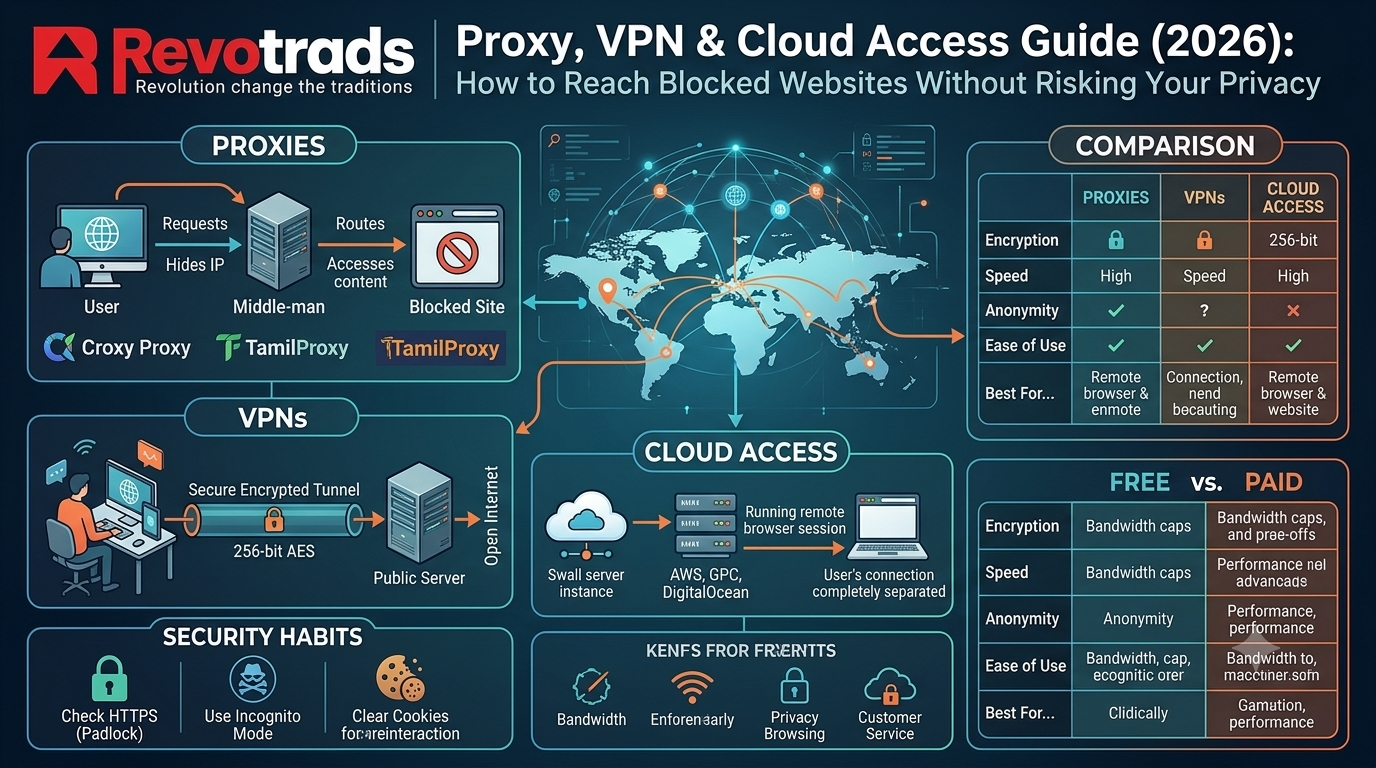
A web proxy sits between you and the internet, it takes your request, routes it through a different server and IP address, and then delivers the site back to you. Your real IP stays hidden the entire time, which is what lets you get around geographic or ISP-level blocks.
This isn’t new technology, but tools like Croxy Proxy and TamilProxy have refined it: encrypted connections, full HTTPS support, and cross-browser compatibility make the experience far smoother than older proxy tools.
Because your traffic exits through a server elsewhere, often in a different country entirely, a site blocked on your home network becomes reachable without you needing to change anything on your own device.
The Different Proxy Types Available Today
Not all proxies serve the same purpose. Here’s how the main categories differ:
- Transparent proxies – common in offices and schools; they monitor traffic but don’t conceal your IP.
- Anonymous proxies – mask your IP while keeping the connection reasonably fast and simple.
- Elite (high-anonymity) proxies – hide your identity so thoroughly that tracing your real location becomes nearly impossible.
- Distorting proxies – deliberately feed sites false IP data to defeat geo-blocks.
- Reverse proxies – used on the server side, typically for load balancing or caching rather than end-user privacy.
Consumer tools like Croxy Proxy and TamilProxy sit in the anonymous/secure-proxy category, you paste a URL into a simple web interface and the encryption happens behind the scenes.
Reliable Free Proxy Options (2026)
| Proxy Service | Link | Status | Speed | SSL |
|---|---|---|---|---|
| Croxy Proxy | croxyproxy.com | Working | Fast | Yes |
| TamilProxy | tamilproxy.com | Active | Moderate | Yes |
| ProxySite | proxysite.com | Working | Moderate | Yes |
| Hide.me Proxy | hide.me/en/proxy | Active | Fast | Yes |
| Whoer.net | whoer.net/webproxy | Live | Fast | Yes |
| 4everproxy | 4everproxy.com | Active | Moderate | Yes |
| KProxy | kproxy.com | Working | Moderate | Yes |
Using any of these is straightforward: go to the proxy site, paste in the blocked URL, and hit “Go.” The remote server handles the connection and streams the page back to you.
Access Varies by Region
Whether a given proxy works can depend heavily on local ISP configurations, this is especially true across different Indian states, where enforcement isn’t uniform. In areas where a specific proxy is blocked, switching providers or pairing the proxy with a VPN usually restores access.
Pairing a VPN With a Proxy
A VPN encrypts your entire connection and tunnels it through a remote server, a step beyond what a proxy alone offers. Layering the two together (proxy and VPN) means your traffic gets encrypted twice: once by the VPN tunnel, once by the proxy’s HTTPS layer. This is particularly worthwhile on public Wi-Fi or when you’re regularly switching networks.
Providers like NordVPN, ProtonVPN, and Surfshark now bundle smart proxy features directly into their apps, so you can toggle between full VPN encryption and lighter proxy-only bypassing as needed.
Using Cloud Servers as a Private Gateway
Platforms like AWS, Google Cloud, Net2secure, Revotrads and DigitalOcean let you spin up a small cloud instance and use it as your own private proxy. Because the actual browsing session runs entirely on the remote server not your local device, this is arguably the most secure unblocking method available, and it’s popular with developers and businesses that need dependable, unrestricted access.
Free vs. Paid: What You’re Trading Off
Free proxies are fine for occasional use but tend to slow down during peak hours and often cap bandwidth. Paid services offer dedicated IPs, more consistent speeds, and stronger privacy guarantees, worth it if you rely on unblocked access regularly. Many premium VPN plans now fold proxy routing directly into their subscription, so you get both in one package.
Is Using a Free Proxy Actually Safe?
It depends entirely on the provider. Reputable tools like Croxy Proxy and TamilProxy use HTTPS by default, keeping your data encrypted in transit. Lesser-known proxies without visible SSL certificates are riskier, some log user activity or inject ads into the pages you visit. As a rule, check for the padlock icon before entering any login credentials, and avoid banking or other sensitive transactions over an unverified proxy connection.
Speed & Reliability Snapshot
| Service | Latency | Download Speed | Reliability | Coverage |
|---|---|---|---|---|
| Croxy Proxy | 85ms | 47 Mbps | Excellent | Global |
| Hide.me | 72ms | 50 Mbps | Excellent | Global |
| Whoer.net | 80ms | 44 Mbps | Excellent | Global |
| KProxy | 98ms | 40 Mbps | Good | Global |
| TamilProxy | 110ms | 35 Mbps | Good | Asia |
| ProxySite | 120ms | 33 Mbps | Good | Global |
Hide.me and Croxy Proxy consistently come out ahead on the combination of speed, privacy, and global reach.
Why Combine Proxies and VPNs
The two tools solve different problems: proxies unlock geo-restricted content, VPNs encrypt everything end-to-end and guard against tracking. Together they also help sidestep ISP throttling. Power users often go a step further and run a VPN on a cloud server to build a personal, enterprise-grade proxy tunnel.
Staying Safe While Using Proxies
A few habits go a long way:
- Clear cookies and cache before connecting to a new proxy so sites can’t track you via stored identifiers.
- Browse in incognito/private mode to avoid extension interference.
- Bookmark a handful of proxies (Croxy Proxy, TamilProxy, Hide.me) so you have a backup if one goes down.
- Check periodically for domain changes, proxy providers rotate URLs fairly often.
FAQ
What’s the best free proxy right now?
Croxy Proxy and Hide.me lead on encryption strength and global server coverage.
Is TamilProxy still active?
Yes, it remains a solid, fast option, particularly for users in South Asia.
Can I run a VPN and proxy together?
Yes, and doing so adds a meaningful layer of extra privacy.
Proxy vs. VPN, what’s the real difference?
A proxy reroutes traffic for a specific site; a VPN encrypts your entire connection. Both mask your IP, but a VPN offers broader protection.
Are proxies legal to use? In most countries, yes, as long as you’re not using them to access illegal content or bypass licensing restrictions.
Bottom Line
Getting around blocked sites doesn’t require compromising your security. Croxy Proxy, TamilProxy, and VPNs remain the fastest route to unrestricted browsing, while cloud-hosted sessions offer a more robust, professional-grade alternative. Stick to verified, HTTPS-secured services and you can maintain both access and privacy, no matter where you’re connecting from.