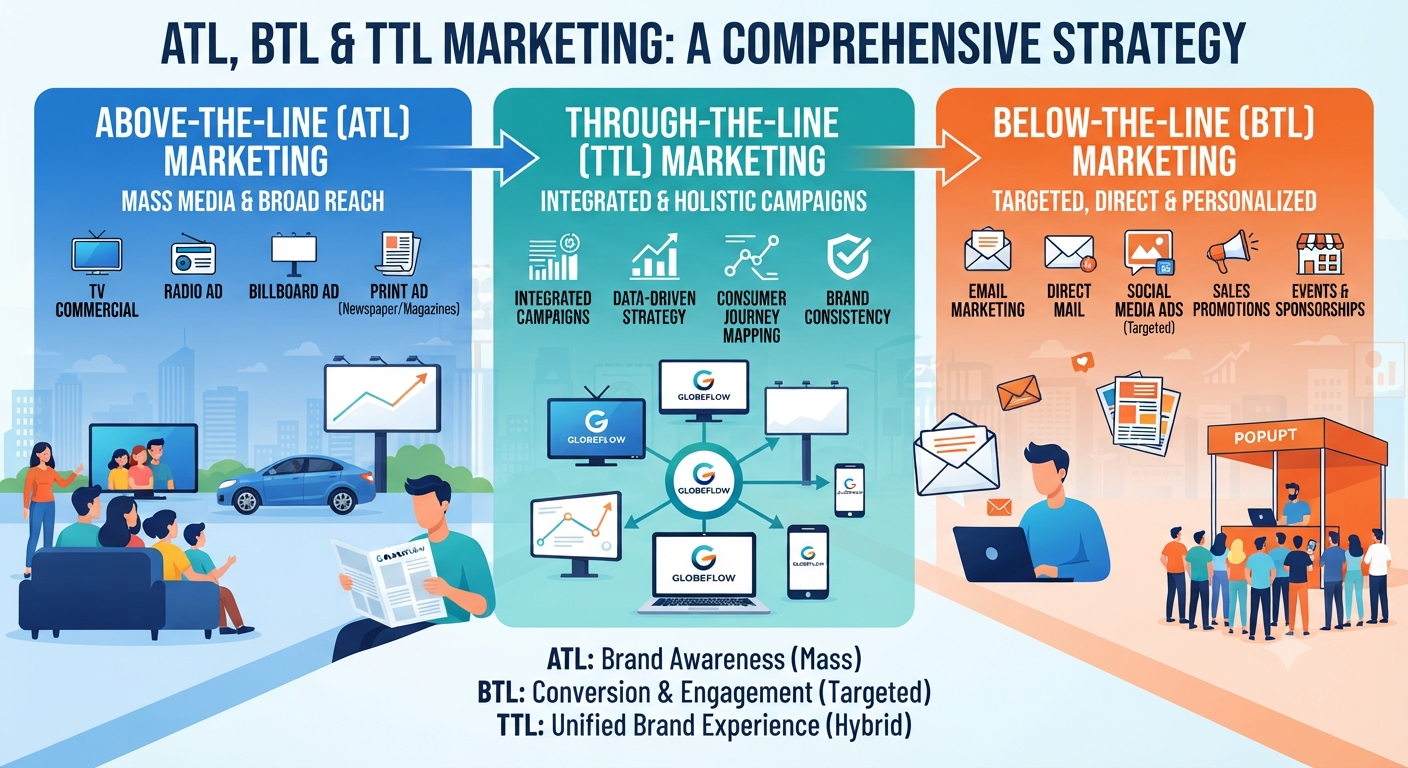
In an era where consumers toggle between streaming television, Instagram Reels, personalized email offers, and in-store experiences: all within the same hour – marketers face a critical challenge: how do you reach audiences without being ignored, and how do you convert attention into action? The answer lies in understanding the three foundational pillars of marketing communication: Above the Line (ATL), Below the Line (BTL), and Through the Line (TTL).
Though these terms originated in the pre-digital age of advertising agencies, they remain remarkably relevant in 2026. In fact, as marketing channels multiply and consumer attention fragments further, the distinction between mass reach and targeted engagement has never been more important. This article unpacks each approach, explores how they interact in today’s omnichannel landscape, and provides a practical framework for building a marketing mix that actually works.
What Is ATL Marketing? (Above the Line)
Above the Line marketing refers to mass media activities designed to build brand awareness among broad, untargeted audiences. The goal is not immediate conversion but rather establishing presence, shaping perception, and creating top-of-mind recall.
Key ATL Channels
- Television Advertising: Despite the rise of streaming, connected TV (CTV) advertising has revitalized television as a precision-targeted medium. In 2026, programmatic TV ads allow brands to serve different creatives to different households watching the same program.
- Radio and Podcasts: Traditional radio maintains reach in commuting demographics, while podcast advertising has exploded, offering host-read endorsements that blend ATL reach with BTL-like intimacy.
- Print Media: Newspapers, magazines, and outdoor billboards continue to deliver in specific contexts, luxury magazines for high-net-worth individuals, transit advertising for urban commuters.
- Cinema Advertising: Pre-roll ads in theaters capture captive, engaged audiences, particularly effective for blockbuster-tied campaigns.
- Outdoor and Digital Out-of-Home (DOOH): Billboards have evolved into dynamic, data-driven displays that change messaging based on weather, traffic, or time of day.
Strengths of ATL
The primary advantage of ATL is scale. A single Super Bowl commercial or a nationwide billboard campaign can put a brand in front of millions simultaneously. ATL builds credibility; there’s a perceived legitimacy that comes with being “big enough” to advertise on television or in premium publications. It also excels at emotional storytelling, long-form video, cinematic audio, and large-format visuals create memorable brand moments that BTL tactics rarely replicate.
Limitations of ATL
The criticism of ATL has always been measurement. John Wanamaker’s famous quote: “Half the money I spend on advertising is wasted; the trouble is I don’t know which half”, still haunts mass media. While attribution has improved with QR codes, vanity URLs, and post-exposure surveys, ATL remains fundamentally a broadcast medium. It is expensive, requires significant minimum investment, and offers limited personalization.
What Is BTL Marketing? (Below the Line)
Below the Line marketing encompasses targeted, direct, and measurable promotional activities aimed at specific consumer segments. Unlike ATL, BTL seeks immediate, trackable responses, whether that’s a purchase, a sign-up, a download, or a store visit.
Key BTL Channels
- Digital Marketing: Search engine marketing (SEM), social media advertising, SEO Services in Noida, display retargeting, and programmatic buying. In 2026, AI-driven personalization means ads can adapt in real-time based on user behavior.
- Email Marketing: Far from dead, email remains one of the highest-ROI channels, especially with hyper-segmentation and predictive send-time optimization.
- Content Marketing: Blogs, whitepapers, webinars, and video tutorials that nurture leads through the funnel.
- Direct Mail: Physical mailers, catalogs, and personalized packages have seen a resurgence as a tactile differentiator in digital-heavy markets.
- Sales Promotions: Coupons, discounts, loyalty programs, and point-of-sale materials.
- Events and Experiential Marketing: Trade shows, pop-ups, product demonstrations, and brand activations.
- Influencer and Affiliate Marketing: Partnerships with creators who promote products to their engaged niche audiences.
Strengths of BTL
BTL’s superpower is precision and measurability. Every dollar spent can be tracked to an outcome. A Google Ads campaign shows exact cost-per-click and conversion rates. An email sequence reveals open rates, click-through rates, and revenue generated. BTL allows for granular audience segmentation, you can target left-handed guitarists in Portland who searched for strings last Tuesday. It is also more budget-flexible; small businesses can start with modest daily ad spends and scale based on performance.
Limitations of BTL
The risk with BTL is saturation and skepticism. Consumers are bombarded with thousands of digital ads daily, leading to banner blindness and ad fatigue. BTL can also feel transactional rather than relational. A brand that only runs performance ads without any broader narrative may drive short-term sales but fail to build long-term equity. Additionally, BTL operates within existing demand, it captures intent but rarely creates it from scratch.
What Is TTL Marketing? (Through the Line)
Through the Line marketing represents the integration of ATL and BTL into a cohesive, omnichannel strategy. Rather than treating mass media and targeted promotions as separate silos, TTL ensures that every touchpoint works in concert to guide consumers from awareness to conversion.
How TTL Works in Practice
Imagine a skincare brand launching a new product line. The TTL approach might look like this:
- ATL Phase: A cinematic television commercial and YouTube pre-roll campaign introduce the product’s origin story and emotional benefits, establishing broad awareness.
- BTL Phase: Viewers who engage with the ad (click, search, or visit the website) are retargeted with personalized Instagram carousel ads featuring before-and-after results and a limited-time discount code.
- Conversion Phase: Those who add to cart but don’t purchase receive an abandoned-cart email with a testimonial video and free shipping offer.
- Retention Phase: Post-purchase, customers enter a loyalty program promoted via SMS and app notifications, while lookalike audiences are built from purchaser data to fuel the next ATL campaign.
This is TTL in action: the brand story starts broad, narrows to the individual, and loops back to inform future mass efforts.
TTL in 2026: The Data-Driven Reality
What makes TTL particularly powerful today is the collapse of the technical barriers between mass and targeted media. Connected TV ads can now include QR codes that feed directly into CRM systems. Podcast host reads can offer unique promo codes that track listener-to-customer journeys. Social platforms allow brands to upload television commercial audiences as custom targeting segments. The line between “above” and “below” has blurred because the infrastructure now supports seamless handoffs.
Artificial intelligence has accelerated this convergence. Predictive analytics can determine which consumers exposed to a billboard campaign are most likely to convert, triggering personalized follow-up sequences automatically. Dynamic creative optimization (DCO) allows a single billboard concept to spawn thousands of personalized digital variants.
ATL vs. BTL vs. TTL: A Side-by-Side Comparison
| Dimension | ATL (Above the Line) | BTL (Below the Line) | TTL (Through the Line) |
|---|---|---|---|
| Primary Objective | Brand awareness, reach, emotional connection | Lead generation, conversions, direct response | Integrated journey from awareness to loyalty |
| Audience | Broad, mass, undifferentiated | Narrow, segmented, highly targeted | Starts broad, progressively narrows |
| Channels | TV, radio, print, cinema, outdoor, CTV | SEM, social ads, email, events, direct mail | All channels orchestrated sequentially |
| Measurability | Difficult; relies on surveys, brand lift studies, media mix modeling | Highly measurable; real-time analytics | Complex but achievable with unified attribution |
| Cost Structure | High fixed costs; economies of scale | Flexible; pay-per-performance options | Requires investment in both plus integration tech |
| Time to Impact | Slow; builds over months | Fast; immediate results possible | Medium; requires setup but compounds over time |
| Best For | New market entry, brand repositioning, maintaining market presence | E-commerce, local businesses, performance goals | Mature brands seeking sustainable growth |
| Key Metric | Reach, impressions, brand recall, share of voice | ROAS, CPA, conversion rate, customer acquisition cost | Customer lifetime value, blended ROAS, brand equity index |
Choosing the Right Mix: A Strategic Framework
No single approach is universally superior. The optimal marketing mix depends on your business stage, industry, budget, and objectives.
When to Prioritize ATL
- You are launching a new brand or entering a new market where awareness is near zero.
- You operate in a category where trust and prestige matter (luxury, automotive, financial services).
- Your product has broad appeal and benefits from emotional storytelling.
- You have sufficient budget to achieve effective frequency (the number of exposures needed to impact memory).
When to Prioritize BTL
- You have a defined target audience with identifiable characteristics and behaviors.
- You operate on a limited budget and need immediate, measurable returns.
- Your sales cycle is short and transactional (e-commerce, SaaS freemium models, local services).
- You have robust first-party data and CRM infrastructure.
When to Invest in TTL
- You are an established brand looking to scale efficiently without sacrificing brand equity.
- You have the technology stack to track cross-channel customer journeys (CDPs, attribution platforms, CRM).
- Your customer lifetime value justifies a longer, more expensive acquisition process.
- You want to build a flywheel where brand awareness feeds performance marketing, and performance data informs brand strategy.
Common Mistakes to Avoid
1. Going All-In on BTL Without Brand Foundation Performance marketers sometimes celebrate killing the brand budget in favor of pure direct response. This is short-sighted. Without brand awareness, cost-per-click rises, conversion rates fall, and customer acquisition becomes increasingly expensive. BTL needs ATL to create the demand it harvests.
2. Treating ATL as Unmeasurable in 2026 The “unmeasurable” excuse no longer holds. Geo-lift studies, brand search volume analysis, incrementality testing, and unified marketing measurement (UMM) models can quantify ATL’s contribution. The tools exist; the willingness to invest in measurement is what separates sophisticated marketers from the rest.
3. Creating Channel Silos Too often, the television team, the social media team, and the email team operate independently with different KPIs and creative strategies. TTL fails when channels compete rather than complement. Organizational alignment is as important as tactical integration.
4. Neglecting Creative Quality In the pursuit of targeting precision, some marketers forget that creative remains the largest driver of advertising effectiveness. A brilliantly targeted but poorly executed ad will underperform a broadly targeted but emotionally resonant one. BTL efficiency should never come at the expense of creative excellence.
The Future: Where ATL, BTL, and TTL Are Heading
As we move deeper into 2026, several trends are reshaping how these categories function:
AI-Generated Personalization at Scale: Generative AI is enabling brands to create millions of ad variants from a single ATL concept, each tailored to individual viewer preferences. The distinction between “one mass message” and “many personalized messages” is dissolving.
Privacy-First Attribution: With third-party cookies largely deprecated and privacy regulations tightening globally, marketers are shifting toward first-party data strategies, media mix modeling, and server-side tracking. This actually strengthens the case for integrated TTL approaches that don’t rely solely on last-click attribution.
Immersive Media: Augmented reality advertising, spatial computing placements, and metaverse brand experiences are creating new channels that defy traditional ATL/BTL categorization. A virtual store activation might reach millions (ATL characteristic) while offering deeply personalized interactions (BTL characteristic).
Sustainability as a Marketing Dimension: Consumers increasingly expect brands to demonstrate environmental responsibility. This is shaping both ATL messaging and BTL product offerings, from carbon-neutral shipping options promoted in email campaigns to sustainability narratives in television advertising.
Conclusion
ATL, BTL, and TTL are not competing philosophies, they are complementary layers of a complete marketing strategy. Above the Line builds the brand that people know and trust. Below the Line converts that awareness into action with precision and efficiency. Through the Line ensures the entire journey feels intentional, connected, and customer-centric.
In 2026, the marketers who win are not those who choose between mass reach and targeted performance, but those who master the choreography between them. The question is no longer “Should we do brand or performance?” but rather “How do we ensure that every performance dollar works harder because of our brand investment, and every brand dollar converts more efficiently because of our performance infrastructure?”
Understanding ATL, BTL, and TTL is not academic nostalgia. It is the strategic vocabulary necessary to build marketing organizations that can both inspire millions and convert individuals, often simultaneously. In a fragmented attention economy, that integration is not just an advantage. It is the only sustainable path to growth.