When you’re starting a new website, one of the key decisions you’ll need to make is selecting the right database. Two popular options you might come across are SQLite and MySQL. Each has its own strengths and weaknesses, and the choice between them can significantly impact your website’s performance and scalability. In this blog post, we’ll dive deep into SQLite vs MySQL and help you understand which database might be the best fit for your project.
What is a Database?
Before we jump into comparing SQLite and MySQL, let’s first define what a database is. A database is a structured collection of data that allows for data storage, retrieval, manipulation, and management. Websites use databases to store everything from user information and content details to transaction records. In short, databases are the backbone of any dynamic website.
Understanding SQLite
Introduction to SQLite
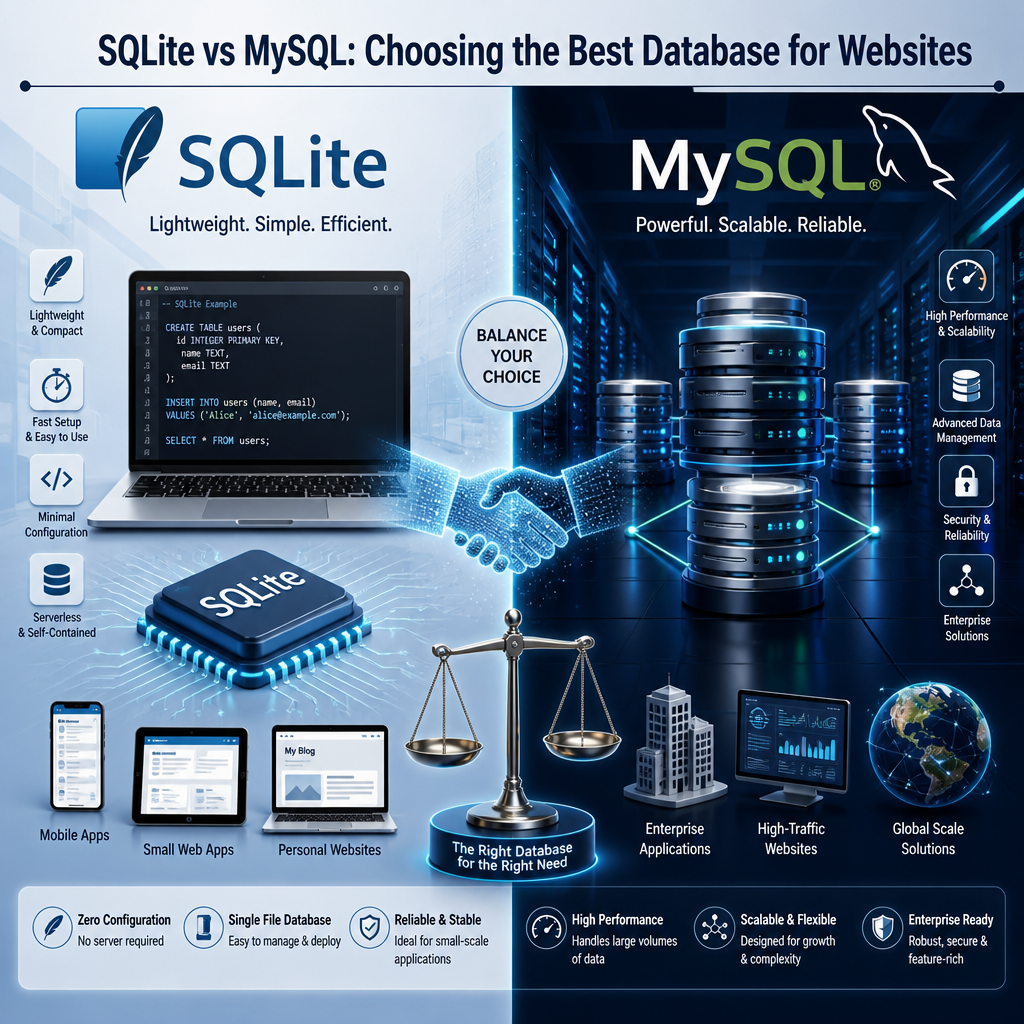
SQLite is an open-source, serverless, self-contained SQL database engine. It’s known for being lightweight and easy to set up, making it an attractive choice for smaller applications and projects. Here are some key characteristics of SQLite:
- Serverless: Unlike other databases, SQLite doesn’t require a separate server process. It’s essentially a library that you integrate into your application.
- Zero Configuration: There’s no setup or configuration required, making it simple to integrate into your project.
- Self-Contained: All the data is stored in a single disk file, which simplifies data management and ensures portability.
- Transaction Support: SQLite supports atomic, consistent, isolated, and durable (ACID) transactions.
When to Use SQLite
SQLite is perfect for small to medium-sized projects or applications where the setup simplicity and minimal requirements are crucial. Consider using SQLite when:
- You’re building mobile apps or desktop software.
- Your application requires a simple and persistent storage solution without the need for a database server.
- Your website or application is expected to handle a low to moderate amount of traffic.
- You need a lightweight database for testing and prototyping.
Understanding MySQL
Introduction to MySQL
MySQL is a widely-used open-source relational database management system (RDBMS). It’s favored for its speed, robustness, and ease of use, making it a popular choice for websites and applications of all sizes. Key features of MySQL include:
- Client-Server Architecture: MySQL operates using a client-server model, which separates the database server from the client application.
- Scalability: MySQL can handle large databases and accommodate growing site traffic with ease.
- Strong Security: MySQL offers advanced security features, ensuring data protection and access control.
- Cross-Platform Support: It supports multiple operating systems, including Windows, Linux, and macOS.
When to Use MySQL
MySQL is suitable for projects that demand high performance, reliability, and advanced security. Consider using MySQL when:
- Your website or application needs to support high traffic and concurrent users.
- You require robust security features for sensitive data.
- Your project demands complex queries, transactions, and data integrity.
- You plan to scale up as your business grows, requiring a scalable database solution.
SQLite vs MySQL: Key Differences
Now that we’ve explored SQLite and MySQL individually, let’s compare their key differences to better understand which might be the right fit for your project.
1. Architecture
SQLite is serverless and operates within the application as a library, while MySQL follows a client-server model. This fundamental difference impacts how each database processes data and supports concurrent user connections.
2. Performance
For read-intensive operations and smaller workloads, SQLite can be faster due to its lightweight nature. However, when it comes to handling large-scale applications with heavy traffic, MySQL excels by effectively managing multiple concurrent connections and complex queries.
3. Scalability
SQLite, although efficient for small to medium projects, is not designed for high scalability. It might struggle as your website grows and attracts more traffic. In contrast, MySQL is built to handle scaling up and can manage databases of significant size while accommodating more users seamlessly.
4. Security
When it comes to security, MySQL offers a range of advanced features including user authentication, access control, and data encryption to protect sensitive information. SQLite has basic security measures, which might not be sufficient for applications that handle confidential user data.
5. Ease of Use
SQLite shines in its simplicity, requiring zero configuration and quick setup, making it ideal for rapid development and testing. MySQL, on the other hand, requires a more complex installation and configuration process but offers a robust platform with greater flexibility.
6. Portability
SQLite databases are stored in a single file that can be easily transferred across devices, which is highly advantageous for applications needing portable data. MySQL, however, requires more effort to export and import data due to its server-based architecture.
Conclusion: Which Database Should You Choose?
The decision between SQLite and MySQL ultimately hinges on your specific project requirements and future goals. If your project is relatively small, with low traffic, and requires rapid development, SQLite may be the best choice. Its simplicity and ease of use make it ideal for applications requiring minimal overhead.
On the other hand, if you’re working on a larger project that expects to grow in complexity and user base over time, MySQL is likely the better option. Its superior scalability, security features, and ability to handle complex queries make it robust enough for demanding applications.
In essence, evaluate your project needs, consider how your site might evolve, and then choose the database that aligns with your objectives. Both SQLite and MySQL offer robust solutions, and the right choice will ensure a solid foundation for your website’s data management.
Whatever decision you make, be assured that both databases are well-supported by large online communities, providing a wealth of resources and helping to ensure your project’s success.