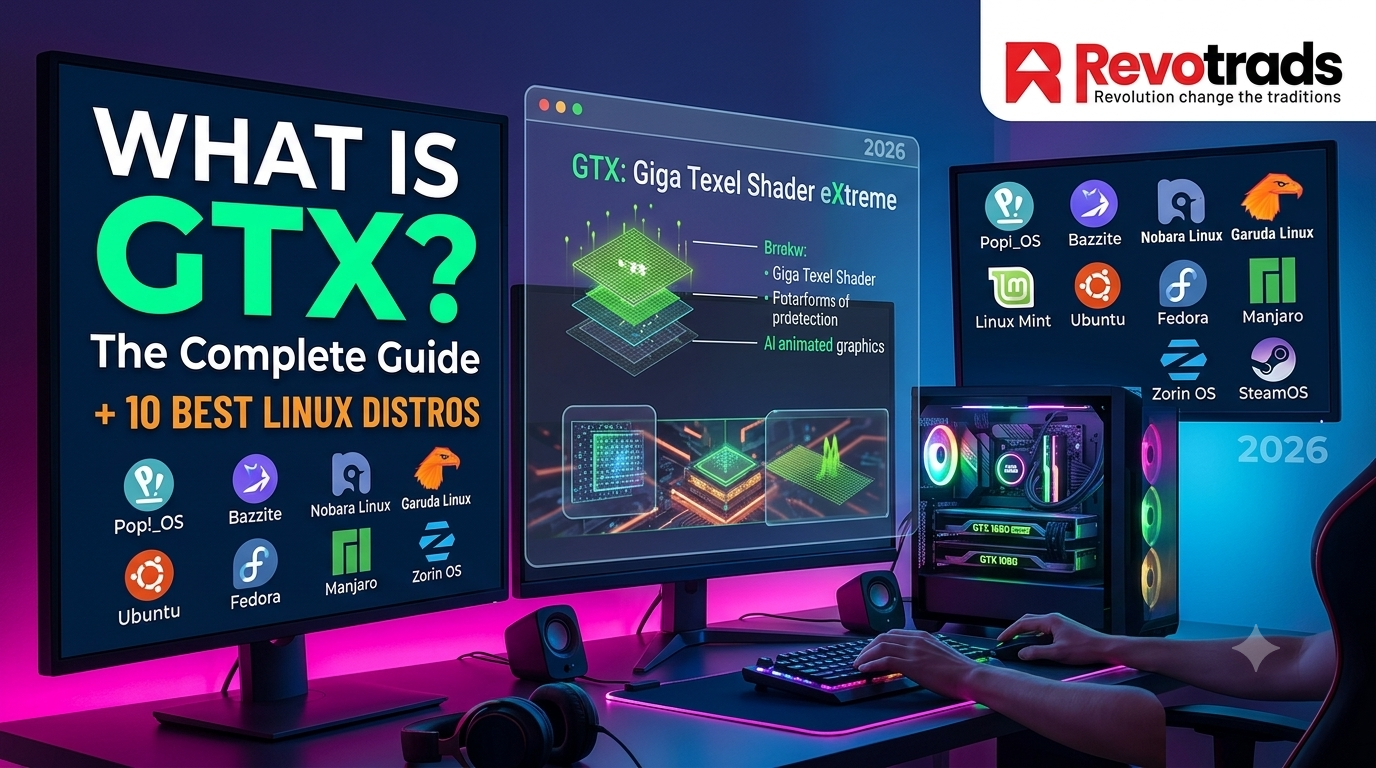
What Does GTX Stand For?
GTX stands for “Giga Texel Shader eXtreme”, a branding designation used by NVIDIA for its high-performance consumer graphics processing units (GPUs). First introduced in 2005 with the GeForce 7800 GTX, the GTX label became synonymous with powerful, gaming-focused graphics cards that dominated the PC gaming market for nearly two decades.
While NVIDIA has shifted its flagship branding to RTX (Ray Tracing Texel eXtreme) since 2018, GTX cards remain widely used in 2026, especially in budget and mid-range gaming builds. Understanding what GTX means helps gamers make informed decisions about hardware compatibility, particularly when choosing a Linux distribution optimized for NVIDIA graphics.
GTX Meaning: Breaking It Down
| Term | Explanation |
| Giga | Refers to billions of operations/texture processing capabilities |
| Texel | A texture pixel, the fundamental unit of texture mapping in 3D graphics |
| Shader | Programmable units that calculate rendering effects (lighting, shadows, color) |
| eXtreme | Denotes high-performance, enthusiast-grade capabilities |
In practical terms, when you see “GTX” on a graphics card, it signals that the GPU is designed for demanding visual workloads, gaming, video editing, 3D rendering, and computational tasks.
What Does GTX Mean in Movies?
You may encounter “GTX” in movie credits or production contexts, though this is rare. In filmmaking, GTX does not have an industry-standard meaning. It occasionally appears as:
• A production company abbreviation (e.g., GTX Studios)
• A codename for visual effects pipelines using NVIDIA hardware
• A filename or project label in rendering farms
However, in 99% of contexts, GTX refers to NVIDIA graphics cards, not cinema terminology. If you’re researching GTX in movies, you’re likely seeing references to post-production houses using GTX-powered workstations for rendering CGI, compositing, and color grading.
What Is a GTX PC?
A GTX PC is simply a personal computer built around an NVIDIA GTX-series graphics card. These systems range from entry-level budget builds to high-performance gaming rigs, depending on which specific GTX card is installed.
Popular GTX Cards Still in Use (2026)
| Card | VRAM | Best For | Linux Driver Support |
| GTX 1650 | 4 GB | Budget 1080p gaming | Excellent |
| GTX 1660 Super | 6 GB | Mid-range 1080p/1440p | Excellent |
| GTX 1080 | 8 GB | High-end 1440p | Excellent |
| GTX 1080 Ti | 11 GB | Enthusiast 1440p/4K | Excellent |
| GTX 750 Ti | 2 GB | Ultra-budget, retro gaming | Good (legacy) |
While newer RTX 40-series and 50-series cards offer ray tracing and DLSS, GTX cards continue to deliver solid 1080p and 1440p performance, especially on Linux, where NVIDIA’s proprietary drivers mature rapidly.
10 Best Linux Distros for GTX Gaming in 2026
If you’re running a GTX-powered PC and want to game on Linux, choosing the right distribution is critical. NVIDIA’s proprietary drivers are required for optimal GTX performance on Linux, and some distros handle this far better than others. Here are the 10 best Linux distros for GTX gaming, ranked by NVIDIA driver integration, performance, and ease of use.
1. Pop!_OS: Best for NVIDIA GTX Out-of-the-Box
| Feature | Details |
| NVIDIA Driver | Pre-installed on dedicated ISO |
| GTX Optimization | Power profiles, GPU switching, CUDA support |
| Desktop | COSMIC (Rust-based) or GNOME |
| Best For | GTX 10-series and 16-series laptops/desktops |
Why It Wins: No manual driver installation. Boot, install, and your GTX card works immediately with full hardware acceleration.
2. Bazzite: Best Immutable Gaming OS for GTX
| Feature | Details |
| NVIDIA Support | Automatic driver layering for GTX/RTX |
| Proton/Steam | GE-Proton pre-configured |
| Update Safety | Atomic updates with rollback |
| Best For | Living room PCs, HTPCs with GTX cards |
GTX Advantage: Bazzite’s immutable base means NVIDIA driver updates never break your system. If a driver update fails, roll back in seconds.
3. Nobara Linux: Best for GTX + AMD Hybrid Setups
| Feature | Details |
| NVIDIA Drivers | Pre-installed, with custom patches |
| Kernel | Low-latency XanMod variant |
| Extras | OBS, Discord, Lutris pre-loaded |
| Best For | Content creators with GTX GPUs |
Why It Works: Nobara applies CPU scheduler tweaks and I/O optimizations that help older GTX cards (like the 1060 or 1650) punch above their weight.
4. Ubuntu LTS: Best for GTX Stability
| Feature | Details |
| Driver Install | ubuntu-drivers autoinstall — one command |
| Long-Term Support | 5 years of updates |
| Steam | Native .deb and Snap packages |
| Best For | Workstations, corporate gaming setups |
Quick Setup:
sudo ubuntu-drivers autoinstall
sudo reboot
5. Linux Mint: Best for GTX Beginners
| Feature | Details |
| Driver Manager | GUI-based NVIDIA driver selection |
| Desktop | Cinnamon (lightweight, familiar) |
| Performance | Low overhead benefits older GTX cards |
| Best For | Migrating Windows gamers with GTX hardware |
6. Garuda Linux: Best for Arch-Based GTX Performance
| Feature | Details |
| NVIDIA Setup | garuda-nvidia-config script |
| Performance | Zram, Ananicy, GameMode pre-tuned |
| AUR Access | Latest NVIDIA drivers immediately |
| Best For | Power users with GTX 1080 Ti/1660 Super |
7. Fedora Workstation: Best for Open-Source Purists with GTX
| Feature | Details |
| Driver Install | RPM Fusion NVIDIA repo |
| Kernel | Bleeding-edge, GTX-optimized |
| Wayland Support | Improved NVIDIA compatibility in 2026 |
| Best For | Developers who also game on GTX cards |
8. Zorin OS: Best Windows Alternative for GTX Gaming
| Feature | Details |
| Driver Support | Built-in NVIDIA driver installer |
| Gaming Mode | System tweaks for maximum FPS |
| Compatibility | Windows app support via Wine |
| Best For | Former Windows gamers with GTX 1650/1660 |
9. Manjaro: Best Rolling Release for GTX
| Feature | Details |
| Auto-Detection | MHWD configures NVIDIA automatically |
| Rolling Updates | Latest drivers without manual intervention |
| Editions | KDE, GNOME, Xfce all NVIDIA-ready |
| Best For | Users who want latest GTX drivers hassle-free |
10. SteamOS / HoloISO: Best Couch Gaming with GTX
| Feature | Details |
| Interface | Big Picture / GameScope |
| Proton | Optimized for Steam library |
| Controller | Unmatched gamepad support |
| Best For | HTPCs with GTX 1050 Ti / 1650 |
GTX vs. RTX: Should You Upgrade for Linux Gaming?
| Factor | GTX Series | RTX Series |
| Ray Tracing | Not supported | Hardware-accelerated |
| DLSS | Not available | DLSS 3/4 on Linux via Proton |
| Driver Support | Mature, stable | Mature, more frequent updates |
| Power Efficiency | Moderate | Superior (especially 40/50-series) |
| Linux Compatibility | Excellent | Excellent |
| Price (2026) | Budget-friendly | Premium |
| Best Use Case | 1080p/1440p gaming | 1440p/4K with ray tracing |
Verdict: If your GTX 1060, 1660, or 1080 still meets your performance needs, there’s no urgent reason to upgrade for Linux gaming. Proton and NVIDIA’s Linux drivers continue to optimize for older hardware.
Essential Tools for GTX Gaming on Linux
| Tool | Purpose | Install Command |
| NVIDIA Drivers | Hardware acceleration | sudo ubuntu-drivers autoinstall |
| Steam + Proton | Windows game compatibility | Flatpak or native package |
| NVIDIA Settings | GPU clock, fan, resolution control | Included with driver |
| MangoHud | In-game FPS/telemetry overlay | sudo apt install mangohud |
| GreenWithEnvy (GWE) | GTX/RTX overclocking on Linux | Flatpak install |
| GameMode | CPU governor optimization | sudo apt install gamemode |
Frequently Asked Questions
1. What does GTX mean?
GTX stands for Giga Texel Shader eXtreme, NVIDIA’s branding for high-performance consumer graphics cards designed for gaming and intensive visual workloads.
2. What does GTX stand for in full?
The full form is Giga Texel Shader eXtreme. It denotes GPUs capable of processing billions of texture pixels with advanced shader programming.
3. Is GTX still good in 2026?
Yes. Cards like the GTX 1660 Super, GTX 1080, and GTX 1080 Ti still deliver excellent 1080p and 1440p gaming performance on Linux with proper NVIDIA drivers.
4. What does GTX mean in movies?
GTX has no standard meaning in cinema. It may appear as a production company name or project codename, but it almost always refers to NVIDIA graphics hardware in creative industry contexts.
5. Can I use GTX cards for Linux gaming?
Absolutely. NVIDIA provides proprietary Linux drivers for all GTX cards, and distributions like Pop!_OS, Nobara, and Bazzite optimize for GTX hardware out of the box.
6. What’s the difference between GTX and RTX?
GTX cards lack hardware ray tracing and DLSS (Deep Learning Super Sampling). RTX cards include dedicated RT cores for ray tracing and Tensor cores for AI-driven upscaling.
7. Which Linux distro is easiest for NVIDIA GTX?
Pop!_OS is the easiest, it offers an ISO with NVIDIA drivers pre-installed. Linux Mint and Zorin OS are excellent alternatives for beginners.
Conclusion
Understanding what GTX means, Giga Texel Shader eXtreme, is the first step toward optimizing your PC gaming experience. While NVIDIA’s marketing has shifted to RTX, millions of GTX cards continue to power capable gaming rigs worldwide, especially on Linux where driver maturity and Proton compatibility have never been better.
Whether you’re running a budget GTX 1650 or a still-potent GTX 1080 Ti, the right Linux distribution transforms your hardware into a smooth, stable gaming platform. From Pop!_OS’s effortless NVIDIA setup to Bazzite’s immutable reliability, there’s a gaming Linux distro perfectly matched to your GTX-powered system.
The penguin and your GTX card? In 2026, they’re a winning combination.
For more hardware guides, Linux tutorials, and gaming benchmarks, visit: revotrads.com.