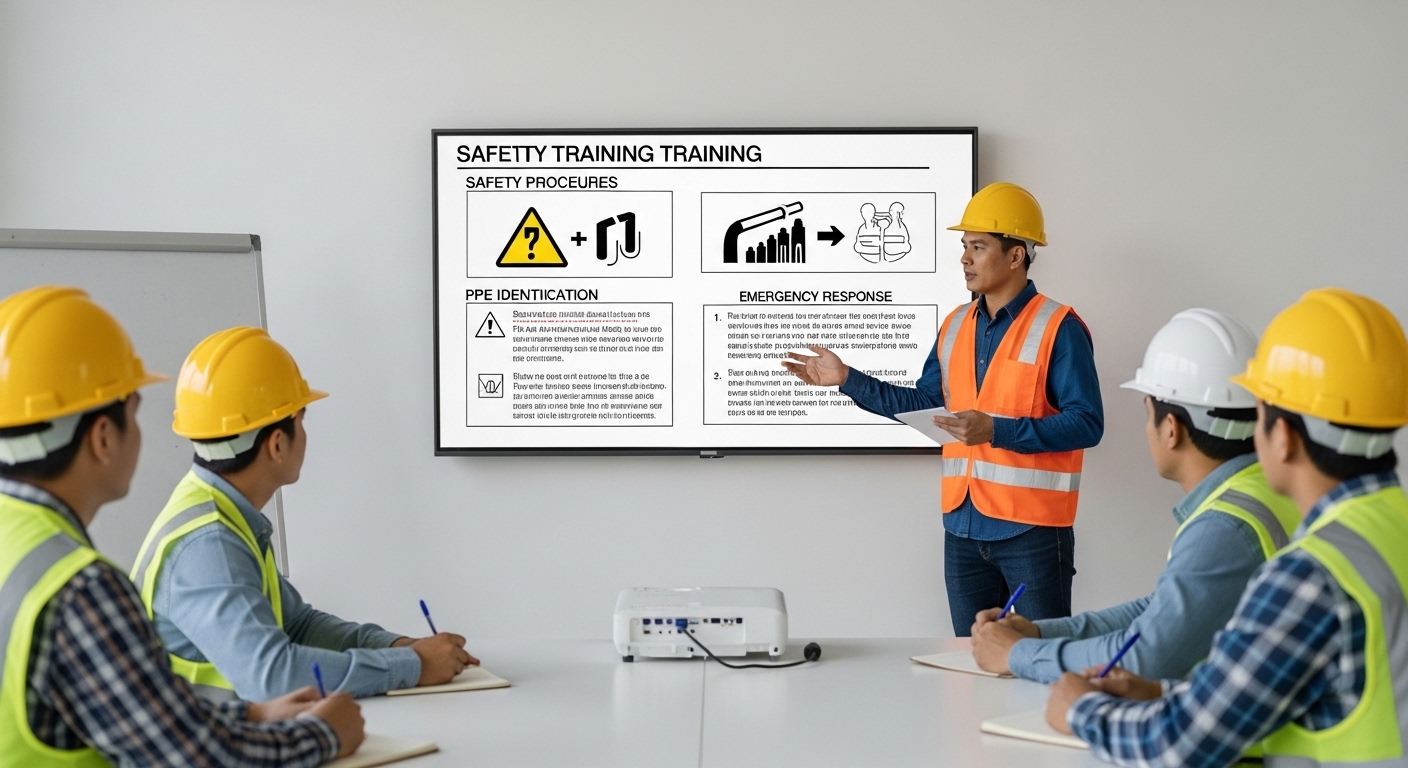
Construction sites by nature are very dangerous, and workers are at risk of various types of accidents, including falls, machinery accidents, electrical shocks, and exposure to harmful chemicals. The construction industry in the U.S. is one of the leading industries in terms of workplace injuries and deaths. For construction companies, having solid safety training programs is the main way of not only protecting employees but also saving on costs and increasing productivity.
A thoroughly designed safety program will equip workers with sufficient knowledge, give them confidence, and make them ready to react appropriately in emergencies. Effective training programs, in addition to merely satisfying OSHA requirements, establish a safety culture that infiltrates every project and raises the level of the whole organization.
How To Lay The Ground For An Effective Safety Training
It is extremely important to make a good start. A training program cannot flourish without the commitment of the management, the existence of clear policies, and a culture that values safety. Management must be the leader in the safety culture. Therefore, they have to set a good example by attending safety meetings and safety educational sessions themselves, and providing the necessary funds for the continuation of education.
Incorporating cost estimating services into your safety programs is a smart way to ensure detailed and proactive planning. These estimating services perform accurate quantity takeoffs and cost analysis, helping companies clearly understand how investments in safety training, personal protective equipment (PPE), and other risk-prevention measures impact overall project budgets. With this insight, businesses can allocate resources more strategically, reduce unforeseen expenses, and strengthen workplace safety. The result is not only a safer workforce but also smoother project execution and improved financial performance.
Job Hazard Analysis
A Job Hazard Analysis (JHA) is very useful in determining the risks of each kind of work. When the hazards are identified before the start of work, the trainers develop specific task-oriented training that concentrates on the usage of these methods in the task at hand. Suppose a scaffolding task requires a particular fall protection training, then the electrical work may focus on lockout/tagout procedures and PPE.
Safety Goals and Metrics
Training effectiveness can be gauged accurately only when a company has set specific goals and has established a system of measuring indicators. Some days in the future, these measures may be the rates of the reduced number of accidents and conformity to safety protocols, as well as the reporting of near-misses. Such data provides the teams with insights that are beneficial for the ongoing safety programs and help in the achievement of better safety standards.
Designing A Comprehensive Training Program
Orientation is just the beginning of a strong program. In addition to being well-structured and engaging, it must also be adaptable to the workforce’s needs.
Orientation And Task-Specific Training
Comprehensive orientation must be the first step for new hires, which should include general site safety rules, OSHA standards, and the company’s policies. However, task-specific training must be given to employees as well, so they are fully aware of the hazards associated with their tasks.
As an example, while crane operators must be given special handling procedures, electricians are supposed to get training focused on lockout/tagout and arc flash hazards. By doing so, workers are not only equipped with the knowledge of the most essential safety issues but also get better at remembering the safety information that is critical.
Train-the-Trainer Programs
One way to improve program effectiveness is to have supervisors and experienced workers train their peers. “Train-the-trainer” programs give it quite a practical touch, allowing the mentor to provide immediate advice and for the mentee to get hands-on guidance and feedback during the course of their work activities. This peer-to-peer learning style helps to further assimilate the challenged knowledge through a culture of shared responsibility.
Digital Learning Platforms
Construction projects taken nowadays often see combinations of far-off locations and diverse teams. By employing digital platforms such as Learning Management Systems (LMS) and mobile applications, it becomes possible for workers to access training content at anytime and from anywhere. Online learning courses can comprise video tutorials, tests, and interactive games, which raise the likelihood that workers will utilize their safety training effectively.
Innovative Approaches To Safety Training
Training methodologies keep changing along with the construction industry. Utilizing new technologies in training sessions at times helps in enhancing the effectiveness and raising learners’ interest.
Virtual And Augmented Reality
Through Virtual Reality (VR) technologies, workers are placed in a simulated environment within which they can practice different scenarios without necessarily putting themselves at risk. They can carry out emergency drills, use equipment, and practice fall protection techniques without worries. In the same vein, Augmented Reality (AR) mixes the physical with digital information, thereby making it easier for workers to spot potential dangers when conducting inspections.
Wearable Technology
Through wearables, it is possible to keep track of worker fatigue, recognize instinctive movements that are unsafe, and even verify usage of personal protective equipment (PPE). When data collected by wearables is utilized in training sessions, the company is thus able to tackle the issue of specific behavior and, in doing so, ensure safer working conditions ahead of time.
Interactive Workshops And Video Learning
A combination of role plays, video demonstrations, and interactive workshops is an effective way of revisiting the learning content. They not only spark participation but also, since they open up room for debate, ensure that the gained knowledge will be put into practice by the workers. The importance of adherence to safety measures through real-life incidents can be revealed more prominently via case studies.
Continuous Improvement And Reinforcement

Developing safety awareness should gradually become a habit rather than being considered as a single event. To become a habit, the knowledge has to be stored in memory through ongoing reinforcement and updating according to changes in the working environment.
Regular Refresher Courses
Workers are reminded through refresher courses of the changes in regulations, equipment, and procedures. These courses can even be administered on an as-needed basis during specific projects or teams and are designed to be relatively brief and tightly focused.
Incident-Based Training Updates
Neither near-misses nor accidents can be treated as wasteful experiences since they serve as examples of how people can learn. Training sessions that take into account safety lessons drawn from real-life experiences increase workers’ awareness of safety and, at the same time, inspire them to be more concerned about it.
Supervisor Safety Walks and Performance Feedback
In order to provide staff members with behavior feedback, supervisors must carry out safety walks on a routine basis, where they observe operations and point out the good and bad practices. Through the use of performance evaluation tests and quizzes, it becomes clearer how well the learning has been absorbed, and this also acts as a measurement instrument for the quality of the training offered by the company.
Recognition And Incentives
Aside from recognizing employees’ efforts to work safely, rewarding those behaviors will urge other employees as well to consistently comply with the procedures. The workforce at large will continue the good practices with the help of the recognition programs, safety awards, and small-motivation initiatives.
Integrating Safety With Compliance
Safety programs need to be in line with federal and state laws that regulate work activities to ensure compliance with the law and to protect the workers at the same time.
Osha And Ansi Compliance
In order to be compliant legally and to reduce the risk of liability, training programs should be aligned with OSHA and ANSI standards relevant to the construction field so that the workers can be up-to-date and trained for their work in a safe manner.
Reporting And Documentation
Keeping detailed and accurate records of all training sessions, certifications, and attendance is very important. Digital recording of training data makes it easier to conduct audits, and it also helps the organization to show that it is complying.
Open Communication Channels
When workers are encouraged to report hazards without the concern of being punished, it strengthens the safety culture. Having open communication gives organizations the opportunity to handle the risks fast and also to modify the training programs as necessary.
Cross-Department Coordination
Safety matters should be a point of concern in all departments, including project management, HR, and operations. By working together, consistency in training can be maintained, and the commitment to safety of the whole company can be reinforced.
Emergency Preparedness
Preparedness is a very important safety item that should be adequately emphasized through training. Therefore, the training curriculum should have an emergency preparedness component that will cover different kinds of emergencies such as fire, falls, electrical hazards, and natural disasters. Periodic drills and scenario-based training help in shortening the time it takes to respond to the emergency and also help in minimizing the effects of the emergency when it happens.
Table: Key Components Of An Effective Safety Training Program
| Component | Description |
| Management Commitment | Leaders actively engage and allocate resources |
| Orientation & Task-Specific | Training tailored to new hires and specific job roles |
| Technology Integration | VR, AR, mobile apps, and LMS platforms for flexible learning |
| Continuous Reinforcement | Refresher courses, incident-based updates, supervisor feedback |
| Compliance & Documentation | OSHA/ANSI standards, record-keeping, and emergency preparedness |
| Recognition & Incentives | Rewarding safe behavior to promote engagement |
Conclusion
Enhancing the safety training programs for construction workers in the U.S. goes beyond simply meeting the regulatory standards; it is a wise investment for a company, as it leads to improved well-being of workers, efficiency of projects, and the company’s good image. By utilizing basic methods, advanced technology, continuous support, and the incorporation of compliance, companies have the potential to greatly lower accidents and develop a safety culture that is always ready and thinking ahead.
Furthermore, the estimating services can be employed to integrate the costs of the training program,s thereby making sure that the training is not only effective but also financially viable. At the end of the day, safer construction sites are a source of joy to all, workers, management, and the entire community.
FAQs
Q1: How Often Should Safety Training Be Conducted?
A: Training should occur at orientation and then periodically monthly, quarterly, or whenever procedures, equipment, or regulations change.
Q2: Is Osha Certification Mandatory For All Workers?
A: OSHA 10 or 30-hour certifications are required for specific roles, depending on job duties and project requirements.
Q3: How Can Vr Or Ar Improve Construction Training?
A: VR immerses workers in realistic hazard scenarios safely, while AR helps identify risks during real-world site inspections.
Q4: How Do I Measure The Effectiveness Of My Safety Program?
A: Use performance metrics, incident tracking, quizzes, and supervisor observations to evaluate knowledge retention and compliance.
Q5: What Steps Can Create A Strong Safety Culture?
A: Leadership involvement, worker participation, open communication, recognition programs, and integrating safety into daily operations foster a robust safety culture.