In today’s fast-paced digital era, website performance plays a critical role in attracting and retaining visitors. One of the most important factors that affect performance is storage technology used by your hosting provider.
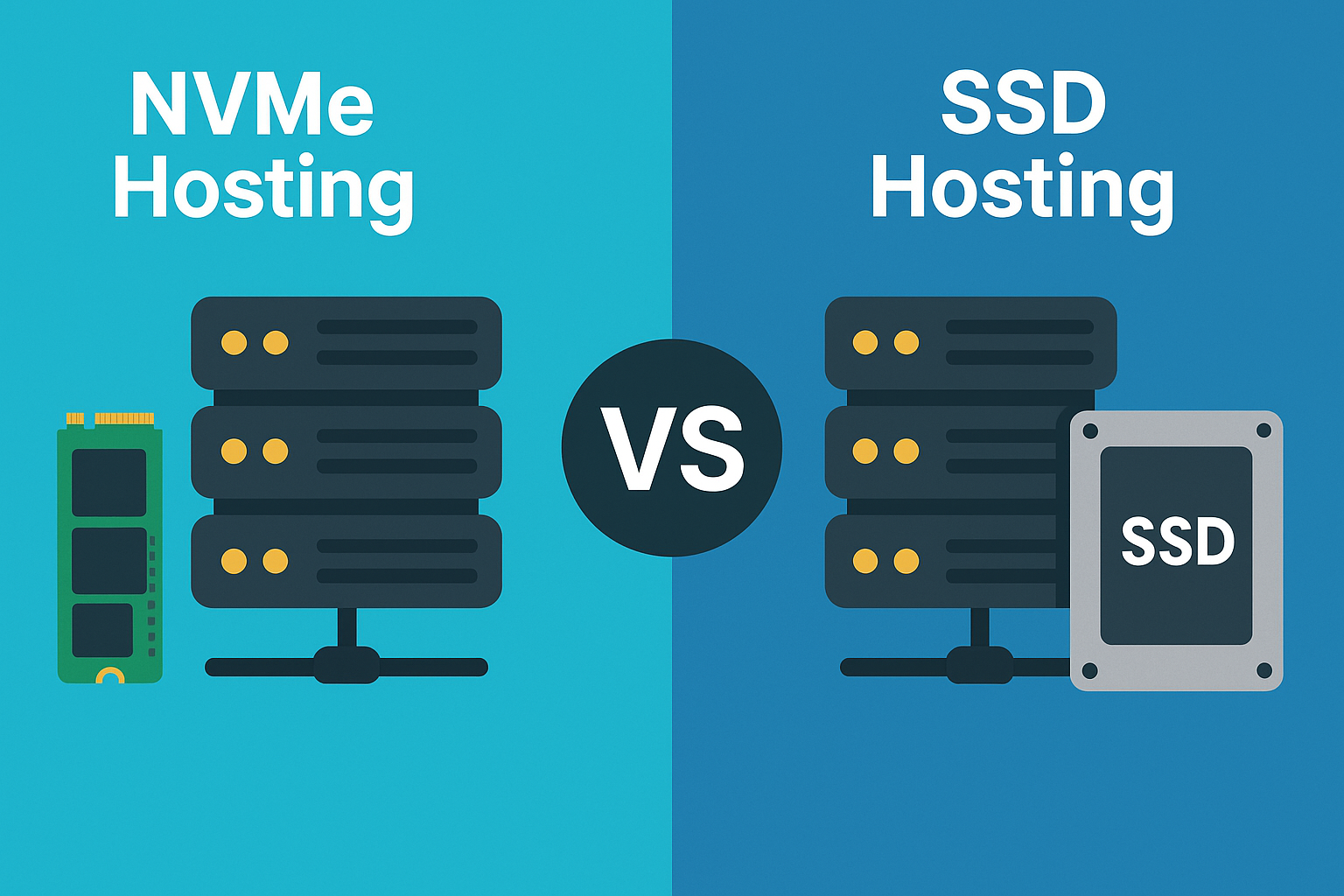
When choosing a web hosting plan, you’ll often come across two common options: SSD Hosting and NVMe Hosting. Both are significantly faster than traditional HDD hosting, but there are important differences in terms of speed, scalability, and pricing.
This guide explores NVMe Hosting vs SSD Hosting in detail, including performance benchmarks, technology differences, pros & cons, pricing, and which one you should choose for your website.
Quick Answer
- SSD Hosting uses SATA SSDs (Solid State Drives), which are much faster than HDDs but limited by SATA connection speeds (up to ~600 MB/s).
- NVMe Hosting uses NVMe SSDs, which leverage the PCIe interface to achieve blazing-fast speeds (up to 7000 MB/s or more).
- In simple terms: All NVMe drives are SSDs, but not all SSDs are NVMe.
NVMe vs SSD Hosting – Key Comparison Table
| Feature | SSD Hosting (SATA SSD) | NVMe Hosting (PCIe NVMe SSD) |
|---|---|---|
| Full Form | Solid State Drive (SATA interface) | Non-Volatile Memory Express (PCIe interface) |
| Read/Write Speed | ~500–600 MB/s | ~3500–7000+ MB/s |
| Latency | ~50–100 microseconds | ~10–20 microseconds |
| Data Transfer Protocol | Uses AHCI (Advanced Host Controller Interface) | Uses NVMe protocol (optimized for SSD) |
| Queue Depth | ~32 commands | Up to 64,000 commands per queue × 64,000 queues |
| Performance in Hosting | Faster than HDD, good for blogs & small sites | Ultra-fast, ideal for eCommerce, SaaS, and heavy apps |
| Price Range | More affordable | Higher cost (premium plans) |
| Best For | Personal blogs, small business sites | High-traffic sites, enterprises, trading, fintech |
Understanding the Technology
SSD Hosting (SATA-based SSDs)
SSD (Solid State Drive) hosting relies on flash memory instead of spinning disks (HDDs). Most hosting companies use SATA SSDs, which are connected using the SATA III interface.
- Speed: Up to 600 MB/s.
- Protocol: Uses AHCI, originally designed for mechanical hard drives.
- Performance: Far better than HDDs, but limited compared to NVMe.
- Use case: Good for shared hosting, blogs, small eCommerce stores, or low to medium traffic websites.
2. NVMe Hosting (PCIe-based SSDs)
NVMe (Non-Volatile Memory Express) is the next generation of SSD storage that connects directly via PCIe (Peripheral Component Interconnect Express) slots.
- Speed: 5x–12x faster than SATA SSDs (3500–7000 MB/s).
- Protocol: Optimized for SSDs, enabling parallelism with thousands of simultaneous queues.
- Performance: Ultra-low latency, extremely high IOPS.
- Use case: Best for large eCommerce stores, SaaS platforms, financial/trading apps, AI/ML, and enterprises.
Performance Benchmarks
Here’s how NVMe vs SSD hosting compares in real-world hosting environments.
| Hosting Task | SSD Hosting (SATA) | NVMe Hosting (PCIe NVMe) |
|---|
| WordPress Page Load Time | ~1.2 seconds | ~0.4 seconds |
| Database Query Speed | ~0.8 ms | ~0.2 ms |
| File Transfer (1GB) | ~20–25 seconds | ~3–5 seconds |
| Concurrent Users | Handles ~500–1000 users | Handles ~3000–5000 users |
| IOPS (Input/Output per sec) | ~75k – 100k | ~600k – 1,000k+ |
Result: NVMe hosting is 3–10x faster across most workloads.
Advantages of SSD Hosting
- Faster than HDD hosting (up to 10x).
- Affordable compared to NVMe.
- Reliable and energy-efficient.
- Sufficient for most personal and business websites.
Limitations:
- Slower than NVMe.
- Limited IOPS and concurrency support.
Advantages of NVMe Hosting
- Blazing fast speeds (up to 7000 MB/s).
- Ultra-low latency (faster response times).
- Handles high concurrency and database-heavy workloads.
- Best for modern apps, SaaS, AI/ML, fintech, trading platforms.
Limitations:
- More expensive.
- Often available only in premium hosting plans.
Pricing Comparison
| Hosting Type | Average Monthly Price (India) | Average Monthly Price (US/Global) |
|---|---|---|
| SSD Hosting | ₹150 – ₹600 /mo | $3 – $8 /mo |
| NVMe Hosting | ₹400 – ₹1500 /mo | $6 – $20 /mo |
While NVMe hosting costs more, the performance benefits justify the price, especially for business-critical websites.
Use Case Scenarios
| Type of Website | Recommended Hosting | Why? |
|---|
| Personal Blogs | SSD Hosting | Budget-friendly, sufficient speed |
| Small Business Websites | SSD Hosting | Handles moderate traffic well |
| eCommerce (WooCommerce, Shopify) | NVMe Hosting | Faster checkouts, better UX |
| SaaS Platforms | NVMe Hosting | High concurrency & reliability |
| Trading & FinTech Apps | NVMe Hosting | Low latency critical |
| AI/ML Applications | NVMe Hosting | Handles heavy computation better |
Future of Hosting: Will NVMe Replace SSD?
Yes — gradually. As NVMe drives become cheaper and more widely available, hosting providers are shifting from SATA SSDs to NVMe-based infrastructure.
- 2023 (Statista): NVMe adoption in data centers surpassed 60%.
- 2025 Prediction: Over 80% of new hosting deployments will be NVMe-first.
So, while SSD hosting won’t vanish anytime soon (due to affordability), NVMe will become the default standard for high-performance hosting.
Frequently Asked Questions (FAQs)
Q1: Is NVMe always better than SSD?
Yes, NVMe is faster and more efficient. But if your website doesn’t need extreme performance, SSD hosting is still a good option.
Q2: Do I need NVMe hosting for WordPress?
If you run a simple blog or business site, SSD hosting works fine. For WooCommerce or high-traffic WordPress sites, NVMe is recommended.
Q3: Is NVMe worth the extra price?
Yes, especially for business websites, eCommerce, or applications where speed = conversions.
Q4: Are all SSDs NVMe?
No. All NVMe drives are SSDs, but not all SSDs use NVMe. Many are SATA-based.
Q5: Which is more reliable – SSD or NVMe?
Both are highly reliable. NVMe offers better performance, but reliability depends more on the hosting provider’s infrastructure.
Conclusion
When comparing NVMe Hosting vs SSD Hosting, the choice depends on your website needs and budget.
- Choose SSD Hosting if you’re running a small site, blog, or portfolio and want an affordable option.
- Choose NVMe Hosting if you need maximum performance, lower latency, and high concurrency support for apps like eCommerce, SaaS, AI, or financial trading platforms.
As the web continues to demand faster load times and smoother user experiences, NVMe hosting is quickly becoming the gold standard.