In today’s digital-first world, every online service – from cloud computing to streaming and online banking – depends on one critical infrastructure: the data center. These facilities are the backbone of the internet, ensuring that businesses, governments, and users access data securely and continuously.
Whether you’re running a startup or managing enterprise-scale IT systems, understanding how data centers and their tiers work helps you make smarter hosting and scalability decisions.
What Is a Data Center?
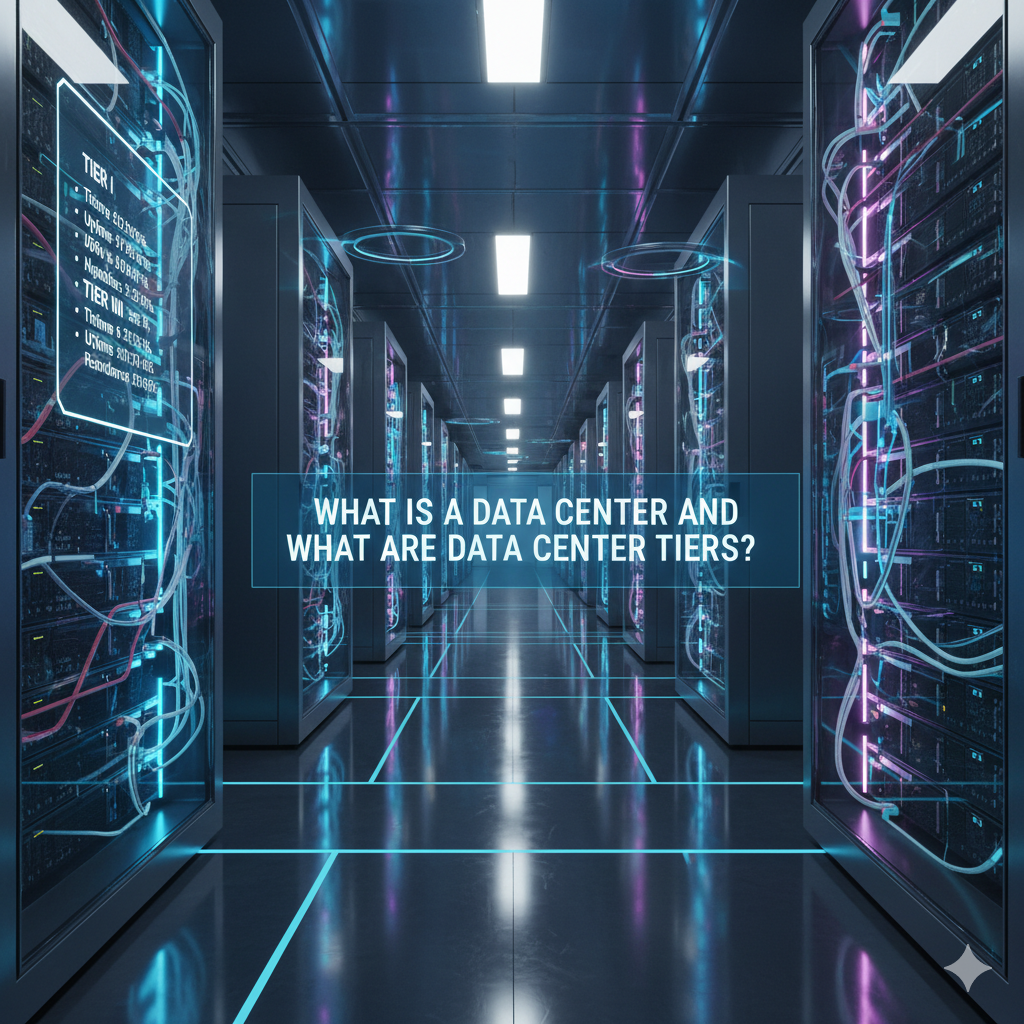
A data center is a physical facility that organizations use to house their critical applications, data, and IT equipment such as servers, storage systems, and networking hardware.
Modern data centers are designed to provide:
- Continuous uptime (typically 99.9% or higher)
- High-speed connectivity
- Advanced security (physical and cyber)
- Scalability and redundancy for growing workloads
Essentially, a data center is where the “cloud” lives – hosting everything from your emails and business applications to entire websites and databases.
Key Components of a Data Center
- Servers: The computing engines that process and deliver data.
- Storage Systems: Devices for holding critical data securely and redundantly.
- Networking Equipment: Routers, switches, and firewalls connecting servers to the internet and to users.
- Power Systems: Redundant UPS and generators ensure zero downtime.
- Cooling and HVAC Systems: Maintain ideal temperature and humidity levels.
- Security: Biometric access, CCTV surveillance, and 24/7 monitoring.
Understanding Data Center Tiers
To measure reliability and performance, data centers are classified into four tiers defined by the Uptime Institute. These tiers indicate redundancy, fault tolerance, and expected uptime.
Tier I – Basic Capacity
- Description: Entry-level infrastructure with limited redundancy.
- Redundancy: No backup components; single path for power and cooling.
- Uptime: 99.671% (~28.8 hours of downtime per year).
- Use Case: Small businesses or startups with limited workloads.
Tier II – Redundant Capacity
- Description: Adds some redundancy and backup systems.
- Redundancy: Partial power and cooling redundancy (N+1).
- Uptime: 99.741% (~22 hours downtime annually).
- Use Case: Growing organizations needing moderate reliability.
Tier III – Concurrently Maintainable
- Description: Allows maintenance without downtime.
- Redundancy: Dual power and cooling paths; one active, one backup.
- Uptime: 99.982% (~1.6 hours downtime per year).
- Use Case: Mid to large enterprises and financial services.
Tier IV – Fault Tolerant
- Use Case: Mission-critical organizations (banks, healthcare, cloud giants).
Description: Highest level of redundancy and uptime. - Redundancy: Fully redundant (2N) power and cooling; fault-tolerant systems.
- Uptime: 99.995% (~26 minutes downtime annually).
Comparison Table: Data Center Tiers
| Tier | Redundancy | Uptime (%) | Annual Downtime | Use Case |
|---|---|---|---|---|
| Tier I | None | 99.671% | ~28.8 hrs | Small businesses |
| Tier II | N+1 | 99.741% | ~22 hrs | SMEs |
| Tier III | N+1 (dual path) | 99.982% | ~1.6 hrs | Enterprises |
| Tier IV | 2N (fault-tolerant) | 99.995% | ~26 min | Mission-critical operations |
Why Data Center Tier Matters?
Data center tiers determine the level of reliability, redundancy, uptime, and fault tolerance a facility can guarantee.
In short:
The higher the Tier, the more reliable and resilient the data center.
1. Uptime & Business Continuity
Every minute of downtime can cost thousands.
Higher-tier data centers ensure maximum uptime through redundant power, cooling, and network paths – minimizing interruptions.
2. Resilience Against Failures
Tier III and Tier IV facilities can handle equipment failures or maintenance without disrupting services.
This fault-tolerance is crucial for 24/7 businesses like e-commerce, banking, and SaaS.
3. Performance & Reliability
A higher-tier data center ensures stable power delivery, climate control, and high-speed networking – directly improving your application’s performance and availability.
4. Security & Compliance
Higher tiers often comply with ISO, SOC 2, PCI DSS, and GDPR standards, ensuring physical and digital security.
This is essential for organizations managing sensitive or regulated data.
5. Long-Term ROI
While Tier III or IV hosting may cost more, it reduces the hidden costs of downtime, data loss, and customer churn – making it a smart long-term investment.
Modern Trends in Data Centers
- Green Data Centers: Focus on energy efficiency and renewable power.
- Edge Computing: Data processed closer to users for lower latency.
- AI-Driven Management: Automated load balancing and predictive maintenance.
- NVMe Storage & 400G Networking: For ultra-fast data throughput.
FAQs – Data Centers and Tiers
Q1: How do I know which tier my business needs?
If uptime and security are critical (like banking or SaaS platforms), Tier III or IV is ideal. Small businesses can start with Tier II for cost efficiency.
Q2: Are Tier IV data centers always necessary?
No. They’re best for mission-critical industries. Most companies operate successfully on Tier III facilities.
Q3: How do data centers maintain uptime during power cuts?
Through redundant UPS systems, diesel generators, and multiple power feeds.
Q4: Can a data center upgrade its tier?
Yes – through infrastructure improvements like dual power paths, better cooling systems, and advanced monitoring tools.
Conclusion
A well-chosen data center is the foundation of digital resilience. Whether you’re managing enterprise workloads or hosting customer websites, understanding data center tiers helps you balance cost, performance, and reliability.
As the demand for low-latency and secure infrastructure grows, the next wave of data centers will combine sustainability with intelligence – ensuring uptime without compromise.