James had two failed app projects behind him before he got one right. The first was a restaurant discovery platform he’d built with a cheap freelance team from a gig marketplace. The app launched, crashed on half the Android devices his friends tested it on, and was quietly abandoned four months later. The second was a corporate training tool he’d commissioned from an agency whose portfolio was impressive and whose communication style turned out to be nonexistent once the contract was signed. That project ran fourteen weeks over schedule, cost forty percent more than the original estimate, and delivered a product that his company’s HR team refused to adopt because the UX was unusable in practice.
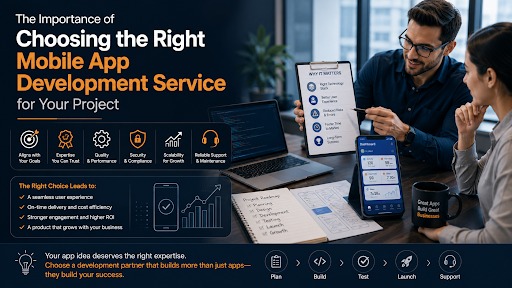
By the time he was ready to start a third project, a field service management tool for a facilities company he’d just joined as operations director, James had a clear view of what had gone wrong twice and a very different approach to finding help. Choosing the right mobile app development service, rather than just choosing a service that was available and affordable, turned out to be the decision that determined whether a project succeeded before the first line of code was written.
Why the Choice of Partner Is a Product Decision
Most non-technical founders and product owners think of hiring a development team as a procurement decision: gather quotes, compare capabilities, pick the best value option. The framing is understandable and consistently leads to bad outcomes because it treats the development team as a vendor executing a specification rather than as a partner shaping the product.
The agency or team a business chooses will make hundreds of decisions during a build that don’t appear in any contract: which architectural patterns to use, how to handle edge cases not covered in the brief, which features to push back on and which to build as specified, how to approach testing, and how to communicate when something unexpected comes up. These decisions shape the product as much as the spec document does, often more, and they reflect the team’s judgment, experience, and values rather than the client’s.
A team with good judgment, genuine experience in the relevant domain, and values aligned with building something that actually works for users will make better decisions on all of those dimensions than a team without those qualities, regardless of what the contract says. Choosing the right partner is the most important product decision that happens before the build starts.
What “Right” Actually Means
Right is specific rather than general. A team that is excellent for one type of project may be wrong for another, and the attributes that make a team right for a project vary by what the project actually is.
Domain experience is the first dimension. A team that has shipped field service management tools before understands the UX requirements for users who are outdoors, physically occupied, and need to accomplish tasks in seconds rather than minutes. They’ve navigated the offline sync challenges that field apps require. They’ve built the integration patterns that connect field data to office-based reporting systems. A team without this experience will work these things out during the build, which means the client pays for the learning curve while the timeline and budget absorb the cost.
Platform expertise is the second dimension. A team whose primary work is in React Native cross-platform development brings different strengths and limitations to a project than a team specializing in native iOS development in Swift, or one that primarily works in Flutter. The right platform for a project depends on requirements that should be discussed before a recommendation is made, and a team that recommends its default stack without engaging with the specific project requirements is optimizing for their own comfort rather than the client’s outcome.
Process maturity is the third dimension, and the one most underweighted in evaluation processes. How a team runs a project, how they communicate, how they handle problems, how they maintain quality across a multi-month build, predicts the experience of working with them more accurately than their portfolio does. A team that demos working software every two weeks, communicates problems early, and documents decisions as they go produces a different experience than one that disappears for weeks and surfaces with a finished product that doesn’t match what was discussed.
The Evaluation Process That Actually Works
How to choose the right mobile app development company is a question that produces a lot of generic advice about checking portfolios and reading reviews. The advice below is more specific, based on what actually separates good selection processes from bad ones.
Send a detailed brief rather than a high-level overview and evaluate agencies on the quality of their response. A good response describes the specific approach they’d take to the project, identifies questions and risks in the brief, and demonstrates that they’ve read and thought about what was sent. A weak response reframes the brief as a capability overview and leads with credentials rather than engagement with the specific problem.
Ask for references from projects similar to yours in type and complexity, and actually call those references. The questions that matter: how accurate was the initial estimate, what was the biggest problem that came up and how did the team handle it, did the delivered product retain users at the rate expected, and would you hire them again for a more complex project?
Request a technical interview that goes into specific decisions relevant to your project rather than a general capabilities presentation. How would they approach offline sync for a field app? What state management pattern would they use for a data-heavy dashboard and why? How have they handled a previous App Store rejection? The specificity of answers reveals genuine experience more reliably than portfolio screenshots.
Evaluate communication style during the sales process as a proxy for communication style during the build. A team that responds thoughtfully, asks good questions, and is honest about what they don’t know is demonstrating the communication behavior you’ll be on the receiving end of for the next several months.
What Bad Selection Looks Like and What It Costs
James’s two failed projects illustrate the two most common failure modes in development partner selection. The first, a cheap gig marketplace team, optimized for cost without considering capability, domain experience, or what quality control process existed between code being written and code being shipped. The result was a product that crashed on real hardware because nobody had tested it properly.
The second, a well-branded agency with poor communication, optimized for apparent credibility without evaluating process quality or asking how the team handled problems during a build. The result was a project that ran over time and budget because problems were hidden rather than surfaced, and a product that failed adoption because user feedback wasn’t incorporated during development.
Both failures were predictable with better evaluation. The gig team’s lack of QA process would have been visible from a technical interview. The agency’s communication problems would have been visible from reference calls with previous clients.
The Compounding Effect of a Right Choice
Choosing the right development partner doesn’t just reduce the risk of project failure. It compounds positively in ways that go beyond the initial build. A team that understands the product and the domain continues improving it after launch, incorporating user feedback into subsequent versions in a way that a team building from a spec document can’t. A team with genuine accountability stays engaged with the product’s success rather than moving on after handoff.
James’s third project, the field service management tool, launched on time and within five percent of the original estimate. The development team had flagged two UX problems during the build that weren’t in the brief, one of which his own operations team confirmed would have caused adoption problems, and both were addressed before launch. The app’s adoption rate among field technicians was significantly higher than his previous corporate tools had achieved.
He attributes the outcome specifically to the evaluation process rather than to luck or to the project being simpler than his previous two. The project wasn’t simpler. The partner was better matched to it, and matching came from understanding what right meant for that specific project before beginning the search.